

Most small shredding jobs are finished within 24 to 48 hours, medium loads take 24 to 72 hours once collection and scheduling are factored in, and large or bulk clear-outs usually wrap up within one to two days despite the sheer volume involved. On-site witnessed shredding gives you the fastest visible proof, while off-site industrial shredding wins on raw throughput. Have your box count and urgency level ready when you book, and the rest falls into place quickly.
TL;DR:
- Small jobs with one to five boxes typically take 24 to 48 hours, with same-day options available through drop-off or quick collection slots.
- Medium jobs involving 10 to 50 boxes generally require 24 to 72 hours, as processing time is brief but transportation scheduling adds delay.
- Large-scale clear-outs often complete within one to two days due to continuous-run industrial shredders, though transport and queue times influence the overall timeline.
- On-site witnessed shredding offers same-day proof with certification immediately upon job completion, while off-site services depend on collection and processing schedules.
- Proper preparation, such as accurate counting, labeling, and removing disallowed items, can significantly reduce delays regardless of the service model chosen.
Table of Contents
- Quick estimates: how long different jobs usually take
- What affects shredding turnaround time
- On-site, off-site and drop-off: what to expect at each stage
- How to plan a fast shredding job
- How Secure-shred handles turnaround
- Why most turnaround advice misses the point
- Book a shredding collection that fits your deadline
- Sources
Quick estimates: how long different jobs usually take
Turnaround time depends far more on volume and service model than most people expect. A single overflowing filing cabinet behaves nothing like a warehouse clear-out, and the two need very different planning.
For small jobs, typically one to five banker’s boxes or a couple of household sacks, you’re usually looking at same-day service or a straightforward 24 to 48-hour window, depending on whether you’re booking a collection or dropping the material off yourself.
Medium jobs, in the 10 to 50 box range, tend to follow a different rhythm. The actual shredding process at a facility often takes only 30 to 60 minutes for smaller volumes within that bracket, but once you add collection scheduling and transport, the total lead time typically stretches to 24 to 72 hours.
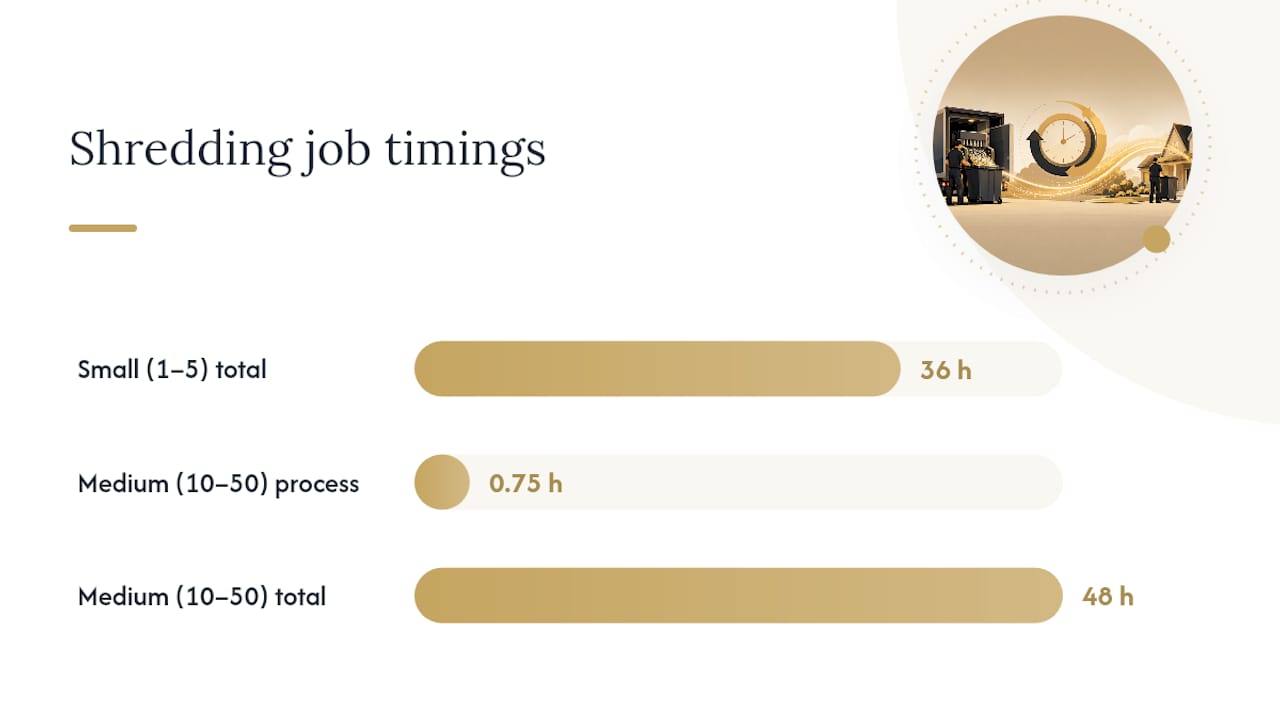
Large and bulk jobs are where industrial equipment changes the maths entirely. A 50-plus box office clear-out or full archive purge sounds daunting, but continuous-run shredders process dozens of boxes an hour once material is loaded. Some manufacturers advertise theoretical outputs of several hundred kilograms per hour, which is why the shredding itself rarely becomes the bottleneck on big jobs. The whole project, from first van arrival to final certificate, usually completes within one to two days, with transport and queue position doing more to shape the timeline than the shredder itself.
Here’s how that breaks down at a glance:
- Small (1 to 5 boxes): Same day to 48 hours, especially via drop-off or a quick collection slot.
- Medium (10 to 50 boxes): 1 to 2 hours of actual processing, 24 to 72 hours total.
- Large (50+ boxes, warehouse or archive clear-outs): Hours of processing capacity, 1 to 2 days total project time.
- On-site witnessed shredding: Often same-day, with a certificate issued the moment the job finishes.
- Off-site facility shredding: Faster raw throughput, but transport time adds to the overall clock.
If you need visible proof there and then, on-site witnessed destruction is worth the slightly higher cost. If your priority is clearing a genuinely large volume as efficiently as possible, off-site facility processing usually gets you there faster overall.
What affects shredding turnaround time
Several operational factors decide whether your job lands at the fast end of these ranges or drags towards the slow end. Understanding them lets you plan around the ones you can control and budget extra time for the ones you can’t.
- Shredder type and throughput. Consumer and office units typically run for only 5 to 30 minutes before needing a cooldown, while industrial machines are built for continuous operation. That gap explains why DIY shredding of anything beyond a handful of boxes becomes painfully slow.
- Provider scheduling load. Turnaround stretches during predictable peaks, particularly the end of the financial year and internal audit periods, when every business seems to want a clear-out at once.
- Distance and transport time. The gap between your collection point and the processing facility adds directly to your total timeline, regardless of how fast the shredder itself runs.
- Security checks and chain of custody. Verifying material, logging collections, and maintaining an audit trail all take a few extra minutes per job, but they’re what makes the certificate of destruction meaningful.
- Customer preparation. Unlabelled boxes, restricted site access, or disallowed materials mixed in with paper all force manual sorting, which is the single most avoidable source of delay.
Equipment features matter here too. Conveyor feeding and PLC controls keep industrial machines running without the constant stop-start of office shredders, and conveyor systems that remove the need for frequent bag changes push effective throughput well beyond what a small business unit could ever manage.
On-site, off-site and drop-off: what to expect at each stage
The service model you choose shapes not just the price but the entire shape of your timeline. Each one follows a distinct sequence, and knowing that sequence helps you set realistic expectations before you book.
On-site witnessed shredding works like this: a vehicle arrives within an agreed window, the operator sets up the shredder at your premises, and destruction happens in front of you, often within the same visit. The certificate of destruction is issued the moment the job is done, which is why this option suits anyone who needs immediate, watched proof.

Off-site collection and facility shredding follows a longer chain: collection window, transport to the facility, queueing behind other jobs, the shredding run itself, then baling or compaction before the certificate is generated. This is where the 24 to 72-hour range comes from, though priority upgrades can compress it.
Drop-off and kiosk services are usually the fastest option for a single small box, provided opening times and walk-in capacity line up with your schedule.
- On-site: same-day, certificate on completion.
- Off-site: 24 to 72 hours standard, priority options available.
- Drop-off: fastest for single boxes, subject to opening hours.
Pro Tip: Ask specifically about same-day cut-off times when booking. Most providers set a firm window, often mid-morning, after which your job automatically shifts to the next available slot.
How to plan a fast shredding job
A little preparation removes almost every avoidable delay from the process. Run through this before you pick up the phone or fill in an online form:
- Count and label your boxes or sacks accurately. Vague estimates lead to under-booked capacity, and under-booked capacity means rescheduling.
- Remove or flag disallowed items such as ring binders, large metal fixings, or bound reports. These force manual sorting on arrival, which eats straight into your turnaround.
- Ask for priority or witnessed slots at the point of booking, and get a clear answer on same-day or next-day cut-offs rather than assuming.
- Check how the certificate of destruction is delivered. Digital copies speed up compliance filing considerably compared with waiting on a posted document, and ask whether GPS tracking or CCTV monitoring forms part of the audit trail.
- Book midweek where possible. End-of-month and end-of-year periods see a surge in demand that pushes even straightforward jobs towards the slower end of the range.
How Secure-shred handles turnaround
The service is structured around three straightforward options: one-off collections for a single clear-out, scheduled recurring collections for businesses generating confidential waste continuously, and drop-off for smaller loads. Each is built to remove the guesswork from your planning.
Every vehicle we run is GPS-tracked, and CCTV monitoring covers the destruction process from collection through to completion. That combination does two jobs at once: it speeds up resolving any query about where your material is in the process, and it gives you solid evidence for compliance if a regulator ever asks.
- One-off collections for urgent or single clear-outs
- Scheduled collections for ongoing business needs
- Drop-off for smaller, self-managed loads
- GPS-tracked vehicles and CCTV monitoring throughout
- Certificate of destruction issued on completion
Accurate booking details and efficient processing help keep total job times tight. Book a one-off collection here when you’re ready.
Why most turnaround advice misses the point
Most guidance on this topic treats shredding turnaround as a fixed number you either get or don’t. That’s the wrong frame. Turnaround is a negotiation between what you prepare and what the provider has available that week, and the reader who wins is the one who shows up with an accurate box count and a clear priority level, not the one who simply asks “how fast can you go?”
The conventional advice, book early and hope, undersells how much control sits with the customer. Removing disallowed items before collection, choosing midweek over end-of-month, and asking direct questions about cut-off times will shave more hours off your job than any provider’s marketing about industrial throughput. Home shredders simply aren’t built for volume, and that mismatch between DIY expectation and machine reality is where most frustration with turnaround actually comes from.
Prioritise preparation over provider-hunting. A well-labelled, accurately counted job booked with the right service model will consistently beat a vague enquiry sent to five companies at once.
— Dan
Book a shredding collection that fits your deadline
For those needing secure shredding services, this provider combines GPS-tracked vehicles, CCTV-monitored destruction, and certificates of destruction issued on completion, ensuring speed and a reliable paper trail.
Services are tailored to volume and deadlines rather than a one-size-fits-all process. Homeowners receive scaled security measures appropriate for smaller loads.
Get a quote for shredding in Cwmbran or explore our full range of services to find the option that matches your timeline.
Sources
- How long can you run a paper shredder? | KAYSWELL
- IDEAL 5009 high-capacity industrial shredder — IDEAL
- Kobra Cyclone industrial shredder — Kobra