
Yes, as a UK business you carry a statutory duty of care for confidential waste under Section 34 of the Environmental Protection Act 1990. You must prevent it escaping your control and transfer it only to an authorised carrier. Keep every Waste Transfer Note and certificate of destruction for at least two years, and your first action today should be moving loose confidential material into locked containers ready for collection.
TL;DR:
- Businesses must verify waste carriers against the Environment Agency’s register and collect detailed, specific descriptions in Waste Transfer Notes for each collection.
- Maintain all waste transfer documentation, including WTNs and certificates of destruction, for at least two years to allow proper legal and regulatory audits.
- Electronic data destruction requires certified wiping, physical destruction, or incineration, with certificates naming specific items and a chain of custody.
- Proper staff training and periodic audits are essential to prevent handling errors and ensure compliance with both environmental and data protection regulations.
- Using a professional, GPS-tracked collection service helps ensure documentation integrity and simplifies fulfilling both environmental and GDPR obligations.
Table of Contents
- What counts as confidential waste and who the duty covers
- The legal duty: Section 34, the code of practice and related regulations
- Step-by-step compliance actions for confidential waste (practical checklist)
- Waste Transfer Notes and recordkeeping: what to record and why two years matters
- Dealing with digital media and non-paper confidential waste
- How a compliant local provider fits the duty of care framework
- What the checklist gets wrong in most guidance
- Book compliant confidential waste collection in Cardiff
- Sources
What counts as confidential waste and who the duty covers
Confidential waste is not limited to paper. It covers anything that identifies a person or reveals sensitive business information, whether it is sitting in a filing cabinet or on a decommissioned laptop. Most business owners picture invoices and letters, but the category is considerably broader than that.
Physical confidential waste in a typical UK office includes:
- HR files, payroll records and employment contracts
- Client and customer files, contracts and correspondence
- Financial records, invoices and bank statements
- Medical or occupational health notes
- Marketing lists, quotes and pricing documents with client names attached
Digital and electronic confidential waste is just as significant, and often overlooked:
- Hard drives and solid-state drives from retired computers and servers
- USB sticks, backup tapes and external drives
- CDs, DVDs and old storage media
- Photocopier and printer hard drives, which retain scanned document images
- Mobile phones and tablets holding business data
Under waste law, this material is “controlled waste” once your business decides to discard it, meaning it falls under the Environmental Protection Act 1990. Household waste has a narrower exemption, but confidential business waste from an office, shop, surgery or workshop does not benefit from that carve-out. If you generate it commercially, the duty applies.
The law also defines who holds responsibility at each stage. A “waste holder” is anyone who produces, imports, keeps, treats, carries or disposes of the waste, which in practice means your business as the producer, any carrier who collects it, any broker who arranges the job, and any dealer who buys or sells waste on. Every one of those roles carries its own share of the duty of care, and none of them can simply pass the liability along without proper documentation.
The legal duty: Section 34, the code of practice and related regulations
Section 34 is short, but it does a lot of work. In plain terms, it requires anyone who handles controlled waste to take all reasonable measures to stop it escaping their control, to transfer it only to someone authorised to receive it, and to provide that person with a written description accurate enough for them to handle and dispose of it lawfully. Confidential documents blowing out of an unlocked skip, or a hard drive handed to an unregistered “man with a van”, both breach this duty regardless of intent.
Data point: breach of the duty of care is a criminal offence under Section 34, and courts have no upper limit on the fine they can impose once a case reaches the Crown Court.
The Secretary of State backs this statute with a waste duty of care code of practice, published jointly by DEFRA and the Environment Agency. The code is not itself law, but it carries real weight in court: it is admissible evidence when a business is prosecuted, and it sets out exactly what “reasonable measures” look like in practice, from checking a carrier’s registration to writing an accurate waste description. Enforcement officers and courts routinely test a business’s conduct against the code’s checklist, so treating it as optional guidance is a mistake.
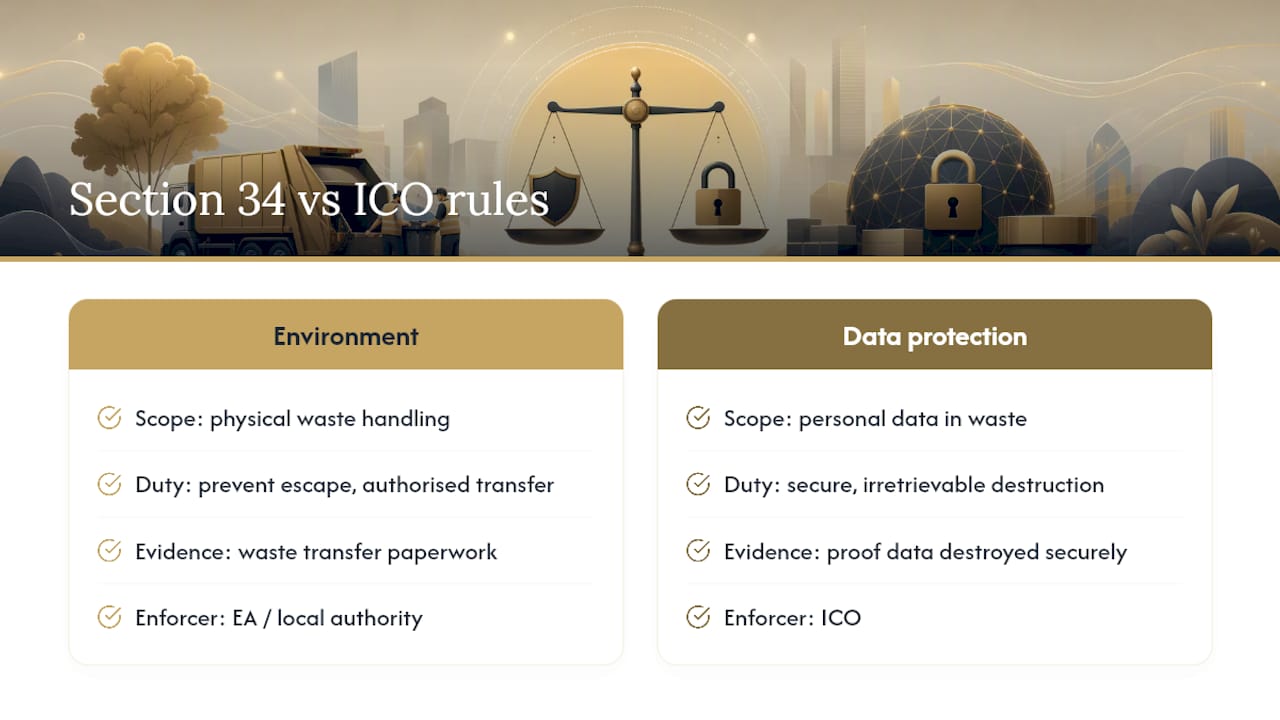
Confidential waste sits at the intersection of two separate legal regimes, and this is where many businesses trip up; for a detailed legal perspective on data protection obligations, see data security overview. Environmental law under Section 34 governs the physical handling and disposal of the waste itself, while the Data Protection Act 2018 and UK GDPR govern the personal data that waste might contain, enforced by the Information Commissioner’s Office. Getting your waste transfer paperwork right satisfies the Environment Agency, but it does not automatically satisfy the ICO. You need both a documented custody trail and evidence that personal data was destroyed securely and irretrievably. Treating the two as one problem, solved by one shredder, is how businesses end up compliant on paper but exposed in reality.
The consequences for getting this wrong scale with the severity of the breach. Minor infringements can attract a fixed penalty notice from the Environment Agency or local authority. More serious or repeated failures move to prosecution, where fines are unlimited and a director can face personal liability if the offence was committed with their consent or through their neglect. Add a linked data breach, and the ICO can impose separate penalties under UK GDPR on top of any environmental enforcement action. Regulators do not treat these as mutually exclusive; a poorly documented confidential waste run can trigger action from both directions at once.
Step-by-step compliance actions for confidential waste (practical checklist)
Meeting your duty of care is not a single decision, it is a sequence of small, consistent habits. Work through these in order and you will cover the ground that actually gets tested when something goes wrong.
- Segregate confidential material at source. Provide locked confidential waste bins or consoles at the point where documents are created, not a general recycling bin. Staff should never have to make a judgement call about what counts as sensitive.
- Label and control access. Mark confidential bins clearly and restrict who can open them. A locked console that only cleaning or facilities staff can access removes the temptation, and the risk, of casual snooping.
- Verify your carrier before you commit to anything. Search the Environment Agency’s public register of waste carriers, brokers and dealers and confirm the registration matches the company collecting your waste, not just a similarly named business.
- Insist on a Waste Transfer Note for every collection. The note must record what was collected, when, who collected it, and where it is going. Without it, you have no evidence the transfer ever happened lawfully.
- Request a Certificate of Destruction for anything containing personal data. This is your proof for the ICO that the data itself, not just the physical material, was destroyed.
- File both documents somewhere retrievable for two years minimum. A shared compliance folder, whether physical or digital, beats scattered emails and paper receipts that vanish when someone leaves the business.
- Train staff on what goes where. A five-minute induction covering confidential bins, screen locks and clean-desk habits prevents most of the everyday breaches that never make headlines but still cost businesses money.
- Audit your own premises and contractors periodically. Walk the office after hours once a quarter. Check bins are locked, consoles are full but not overflowing, and your contractor’s collection times match what is on the contract.
Pro Tip: Keep a single-page compliance log per quarter listing collection dates, carrier registration numbers and certificate references. When an auditor or the ICO asks for evidence, a tidy log answers most questions before they are even fully asked.
Choosing a carrier deserves particular care because it is the step most businesses rush. A registration number on a van livery means nothing until you have checked it against the Environment Agency’s own record, because logos and slogans are easy to copy and registrations do occasionally lapse without a business noticing. Ask directly whether the carrier is registered for the type of waste you are handing over, since some registrations cover general waste but not electronic or hazardous items, and confidential material that includes batteries or circuit boards can fall into that latter category.
The paperwork itself deserves the same scrutiny. A Waste Transfer Note is only useful if it is specific: vague descriptions like “office waste” do not demonstrate that confidential material was handled appropriately, whereas “mixed confidential paper and electronic media, 12 sacks and 4 hard drives” gives you something defensible. Certificates of destruction should reference the collection date and, ideally, a batch or job number that ties back to your WTN, so the two documents corroborate each other rather than sitting as unconnected pieces of paper.
Staff training is the cheapest control on this list and the one most often skipped. A member of staff who throws a client file in the general bin because nobody told them otherwise has just created a liability that no amount of downstream paperwork can fix. Fifteen minutes at onboarding, repeated annually, closes that gap for the cost of a coffee break.
Waste Transfer Notes and recordkeeping: what to record and why two years matters
A Waste Transfer Note is the document that proves custody of your waste passed from your business to someone legally entitled to take it. Without one, you have no defence if that waste turns up somewhere it should not, whether that means fly-tipped paperwork or a hard drive resold with data still on it.
A properly completed WTN should record:
- A description of the waste detailed enough to identify what was handled (not just “general waste”)
- The quantity collected, in sacks, bins or units
- The date and time of collection
- The names, addresses and carrier registration numbers of both parties
- The site the waste is being taken to for treatment or disposal
Businesses in England and Wales must retain WTNs and related records for a minimum of two years. That retention period exists because enforcement investigations and insurance claims rarely happen on the day of collection; they surface months or years later, when a data breach is traced back or a compliance audit asks for evidence. A business that cannot produce a WTN for a collection from eighteen months ago is, functionally, in the same position as one that never had it.
GOV.UK now offers a route to modernise this process through its digital waste tracking service registration guidance, which is gradually replacing paper-based transfer notes with a searchable digital record. Digital tracking removes the risk of a WTN being lost in a filing cabinet or left on a van dashboard, and it makes producing evidence for an audit considerably faster.
Whichever format you use, store WTNs and certificates somewhere separate from general business correspondence. A dedicated compliance folder, cloud-stored with restricted access, means that when the ICO or Environment Agency ask for proof, you are retrieving it in minutes rather than searching through years of email threads.
Dealing with digital media and non-paper confidential waste
Shredding paper is straightforward. Destroying data-bearing electronic media is a different problem entirely, and it is where a lot of well-meaning businesses get caught out.
A hard drive that has simply been wiped or formatted is not destroyed; specialist recovery tools can often retrieve data from drives that appear blank to a normal user. Physical destruction, certified data-wiping to recognised standards, or high-temperature incineration for particularly sensitive or restricted material are the routes that actually eliminate the risk, rather than just hiding it.
Practical options for small and medium businesses include:
- Certified data-wiping, suitable for drives being reused or resold, where a documented process overwrites the data multiple times
- Physical destruction, where drives are shredded or crushed and cannot be reassembled or read
- High-temperature incineration, reserved for the most sensitive material where even destroyed fragments must not be reconstructible
- On-site destruction, where a mobile unit shreds material at your premises so nothing leaves the building intact
- Scheduled pickups or drop-off services, useful for businesses generating a steady but modest volume of electronic waste
Whichever method you choose, insist on a certificate of destruction that names the specific items destroyed, ideally by serial number for hard drives, along with a documented chain of custody from collection to destruction. Industry-standard practice among UK shredding and recycling providers is to issue exactly this kind of certificate alongside an audited chain of custody, and it is worth asking any provider you use whether they do the same as standard, or as an extra.
How a compliant local provider fits the duty of care framework
Using a professional destruction service does not remove your legal responsibility, it discharges it, provided the paperwork backs that up. You remain the waste producer under Section 34 until custody genuinely transfers, and that transfer only counts once it is recorded with a signed Waste Transfer Note.
Some professional shredding services operate on that principle for homes and small to medium businesses across various areas. They may use GPS-tracked vehicles and include CCTV monitoring, providing traceability from collection through to destruction rather than a vague assurance that the job “was done”. Jobs typically come with certificates of destruction and compliance documentation, which serves as evidence businesses need on file for the two-year retention period.
The right moment to bring in a service like this is usually one of three scenarios: a regular scheduled collection for ongoing confidential paper waste, a one-off archive clear-out when you are moving premises or digitising records, or a dedicated hard-drive destruction job when hardware is retired. In every case, the checklist is the same: confirm registration, insist on documentation, and file it before you forget it exists.
What the checklist gets wrong in most guidance
Most compliance guidance treats confidential waste as an environmental problem with a data-protection footnote. That gets the emphasis backwards for most UK businesses, because the actual failures regulators pursue are rarely about the physical waste itself. They are about missing paperwork.
The code of practice makes this explicit: enforcement investigations lean heavily on documentation and evident storage failures, not on abstract questions about whether your shredding was thorough enough. A business with immaculate shredding but no Waste Transfer Note is more exposed than one with an average shredding contract and a complete paper trail.
If you take one thing from this, prioritise the boring part first. Get your carrier verified, your WTNs filed and your certificates matched to collection dates, before you spend energy comparing shredding particle sizes or debating on-site versus off-site destruction. The paperwork is what a regulator actually asks for. Everything else is secondary once that foundation is solid.
— Dan
Book compliant confidential waste collection in Cardiff
Some shredding services offer a practical alternative to juggling multiple compliance systems yourself, providing businesses with a single point of contact for both physical destruction and the evidence trail regulators expect. Where a DIY approach leaves you sourcing your own carrier, chasing your own paperwork and hoping your filing is in order if the ICO ever calls, these services may bundle GPS-tracked collection, CCTV-monitored handling and a signed certificate of destruction into every job.
Whether you need a single archive clear-out, hard-drive destruction for retired equipment, or a scheduled collection that fits around your office routine, the full range of shredding services covers both one-off and recurring needs alike. Every job comes with the documentation you need to satisfy both environmental and data-protection obligations, filed and ready before an auditor ever asks. For businesses that want the destruction to happen off-site with the same audited paper trail, the one-off collection service is built for exactly that.
If you are ready to move confidential material out of your storeroom and off your risk register, get a quick quote today and book your first collection.
Sources
Keep the code of practice, carrier register, and your WTNs and certificates on file, checked and current.
- Section 34, Environmental Protection Act 1990
- Waste duty of care: code of practice (DEFRA / Environment Agency)
- Business duty of care guidance (local authority example)
- Environment Agency waste carriers, brokers and dealers public register