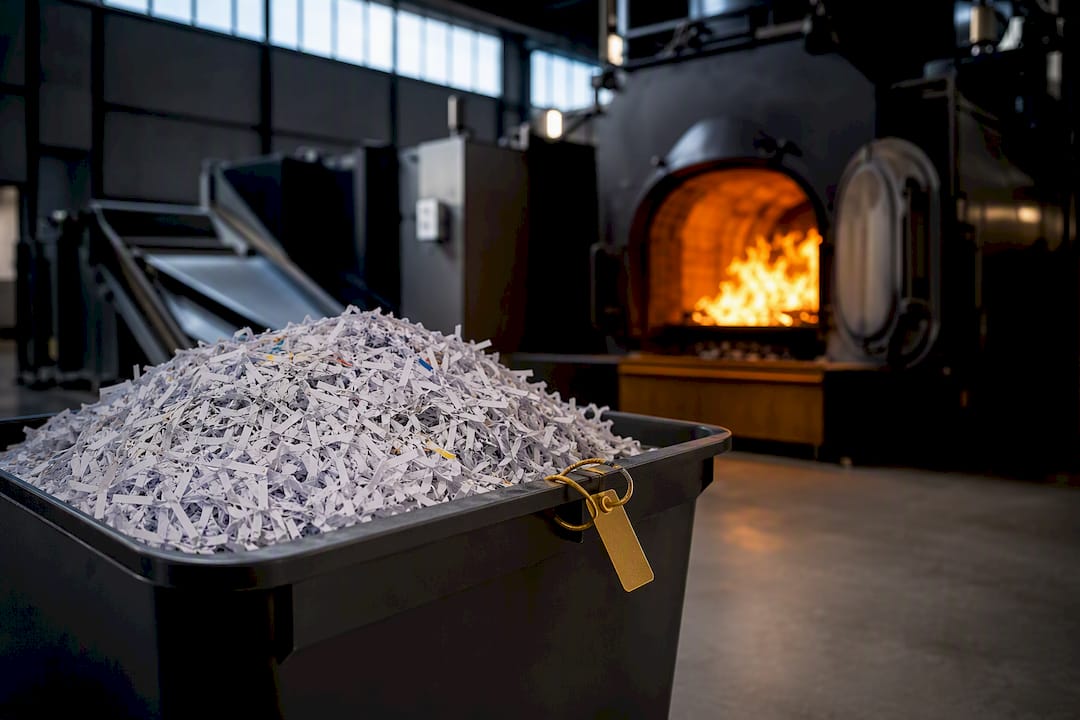
Certified shredding is the safer, auditable default for destroying sensitive paper, giving you a verifiable chain of custody that backyard burning simply cannot match. Industrial incineration only reaches equivalent security when it runs through a licensed high-temperature facility with proper emissions controls, not a bonfire in the garden. For most homes and businesses in Cardiff, using a professional shredding service offers the quickest route to compliant, environmentally sound destruction.
TL;DR:
- Certified shredding provides a verifiable chain of custody and security standards, unlike backyard burning which often leaves recoverable fragments.
- Industrial incineration only achieves complete destruction when conducted at temperatures above 850°C in licensed facilities with proper emissions controls.
- Burning produces toxic emissions like dioxins and particulates, whereas shredding avoids pollution entirely by bypassing combustion.
- Proper proof of destruction, including certificates and GPS tracking, is essential for compliance and is typically provided only by professional shredding services.
- For most households and small businesses, scheduled certified shredding is safer, faster, and more reliable than informal or home incineration.
Table of Contents
- Incineration vs shredding: how each method actually stops reconstruction
- Safety and environmental impact: emissions, fire risk and what happens to the ash
- What proof do regulators expect for document destruction?
- Which method suits your volume and waste type?
- What to do next: a short checklist before you choose
- Why the “just burn it” advice keeps circulating, and why it’s wrong
- A compliant, local way to put this into practice
- Sources
- FAQ
Incineration vs shredding: how each method actually stops reconstruction
Security comes down to one question: could someone piece your documents back together afterwards? Shredding and burning answer that question very differently.
Cross-cut and micro-cut shredders slice paper into hundreds of small, irregularly shaped pieces rather than long strips. That randomness is what defeats reconstruction. The industry benchmark here is DIN 66399, which grades shredders into security levels known as P-levels, from P-1 (wide strips, minimal security) up to P-7 (particle sizes small enough for top-secret material). A provider working to a recognised P-level gives you something burning cannot: a measurable, auditable security standard.
Burning looks final, but it rarely is. Documents thrown onto a garden fire or into a burn barrel tend to clump together, and heat struggles to penetrate a tightly packed stack.
- Outer pages char and blacken, but inner sheets often survive with legible text intact.
- Forensic examiners regularly recover readable fragments from burn piles precisely because of this uneven heat penetration.
- Wind, damp paper, and inconsistent fuel all make the outcome unpredictable.
Industrial incineration is different, but only within the right conditions. Licensed facilities operate at temperatures between 850°C and 1,200°C, hot enough and sustained long enough to achieve complete combustion rather than the patchy scorching of a backyard fire. That statistic matters because it is the dividing line between “burned” and “destroyed”: below it, recoverable fragments are common; within that range, in a controlled plant, they are not.
Safety and environmental impact: emissions, fire risk and what happens to the ash
Uncontrolled burning does not just risk leaving your documents readable. It also puts something nastier into the air.
Low-temperature, incomplete combustion is a recognised driver of dioxin formation, and open burning of household waste is a documented source of these toxic emissions. Dioxins are persistent pollutants linked to serious long-term health effects, and they form in greater concentrations precisely when combustion is inefficient, which describes almost every garden fire or burn barrel. That is also why many local authorities restrict or ban open burning through garden bonfire rules: the smoke and particulates it produces are a genuine nuisance and health concern for neighbours.
Shredding sidesteps this problem entirely. There’s no combustion, so there are no dioxins, no particulates, and no smoke complaints from next door.
- Shredded paper fibre can go straight into the recycling stream rather than the atmosphere.
- No flue-gas cleaning or ash disposal is required, because nothing is burned.
- The material stays within a circular economy instead of being converted to airborne pollutants and ash.
Licensed industrial incineration sits somewhere in between. Modern plants use flue-gas cleaning systems to control what escapes the stack, and energy-from-waste facilities can recover usable energy from combustion, which is a genuine environmental upside where recycling genuinely isn’t an option. But that process still generates bottom ash and fly ash that need proper handling, and the EU’s BAT reference document for waste incineration sets out exactly how demanding that pretreatment and monitoring has to be to keep emissions within acceptable limits. Without those controls, you are not looking at incineration in any meaningful regulatory sense. You are looking at a fire.
What proof do regulators expect for document destruction?
If your business handles personal or financial data, destroying it is only half the job. Being able to prove you destroyed it properly is the other half, and this is where informal burning falls apart completely.
A proper certificate of destruction should record the date of destruction, the volume processed, the method used, and a documented chain of custody from collection through to final disposal. Auditors and data protection officers expect this kind of paperwork during inspections, and lack of it may be considered a compliance issue.
Burning a bin bag of files in the garden produces none of this. There’s no third-party record, no timestamp, and no evidence trail if a regulator or a client ever asks what happened to their data. Compare that with a certified shredding provider, which typically supplies:
- A signed certificate confirming date, volume, and method of destruction.
- GPS and CCTV records showing the collection and transport chain.
- Documentation that satisfies GDPR and ICO expectations around data disposal.
Licensed incineration facilities can provide similar documentation only when waste is processed through permitted plants with proper pretreatment and monitoring; informal burning does not meet this standard.
Pro Tip: Ask any provider to show you a sample certificate of destruction before you book. If they can’t produce one on request, that tells you everything you need to know about their audit trail.
Which method suits your volume and waste type?
Matching the method to the material matters more than picking a single “best” answer.
- Routine confidential paperwork at home or in a small business. Scheduled or one-off certified shredding handles this cleanly, whether that’s a monthly office collection or a single archive clear-out.
- Larger volumes or mixed hazardous waste streams. Licensed incineration or waste-to-energy plants become relevant here, particularly where material can’t be recycled and needs pretreatment before combustion.
- Digital media alongside paper records. Hard drives, tapes, and other electronic media need separate destruction routes; a partner specialising in IT asset disposition can handle end-of-life hardware alongside your paper shredding.
Cost tends to follow logistics more than the destruction method itself. Shredding scales easily, from a single pay-as-you-go sack to weekly commercial collections, while incineration usually demands transport to a distant licensed facility plus pretreatment costs that only make sense at real scale.
What to do next: a short checklist before you choose
Certified shredding remains the right call for the overwhelming majority of sensitive paper, at home or in the office. Request a certificate of destruction every time, whatever provider you use.
Before booking anyone, check for:
- A written certificate of destruction issued after every job.
- CCTV and GPS tracking on collection vehicles for a verifiable chain of custody.
- A stated shredding standard, ideally referencing DIN 66399 or an equivalent P-level.
- A clear recycling policy for the shredded fibre once it leaves the site.
Pro Tip: If a business ever recommends incineration for everyday office paper, ask which licensed facility they use and request the same documentation you’d expect from a shredding certificate. If they can’t name one, that’s a red flag, not a green light.
Why the “just burn it” advice keeps circulating, and why it’s wrong
People reach for burning because it feels final. Flames, smoke, ash. It looks like destruction in a way that a shredded pile of confetti somehow doesn’t, even though the confetti is the one that’s actually unreadable.
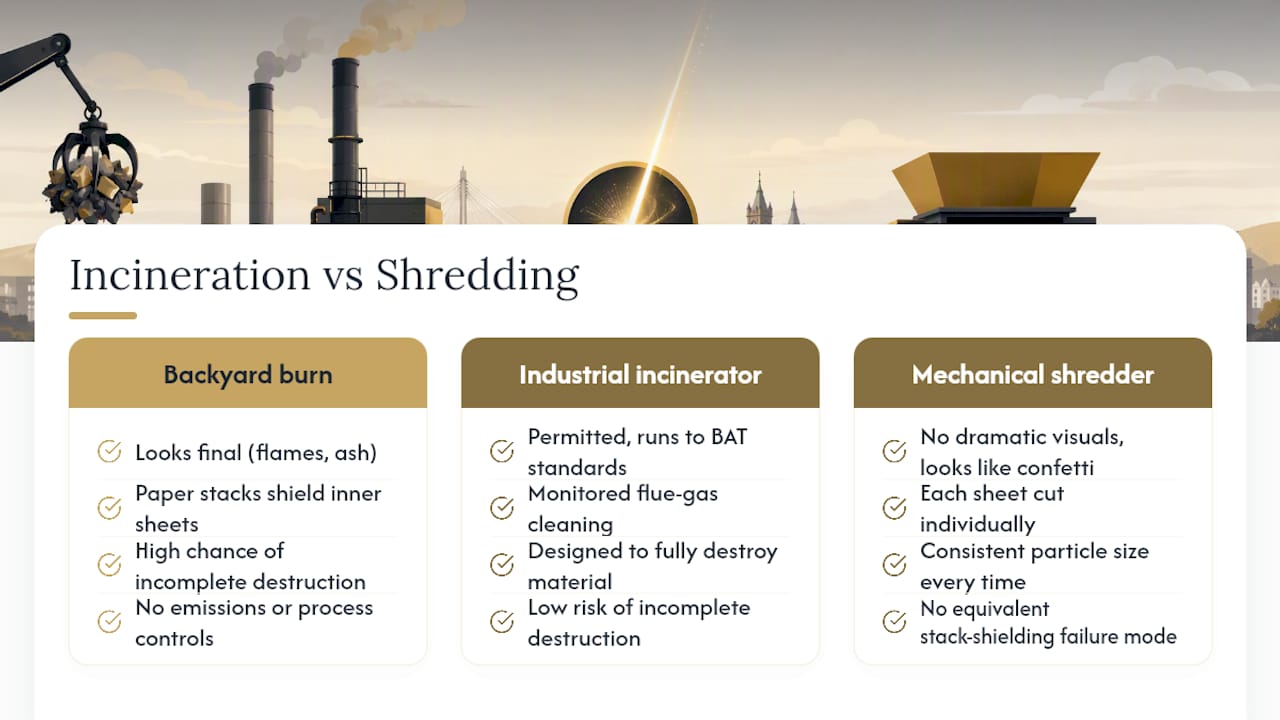
That instinct is the problem. The most common failure in manual burning isn’t a rare accident. It’s the default outcome, because paper insulates itself against its own destruction, stacking together and shielding inner sheets from the heat that’s supposed to destroy them. Mechanical shredding has no equivalent failure mode, because every sheet passes through the cutting mechanism individually, to a controlled particle size, every single time.
The other thing conventional advice gets wrong is treating incineration as a single category. There’s a vast gulf between a permitted facility running to BAT standards with monitored flue-gas cleaning, and a bin fire in a backyard. Lumping them together as “burning” is what leads people to believe backyard incineration is a legitimate shortcut. It isn’t, and treating it as equivalent to either proper shredding or genuine industrial incineration does a disservice to anyone trying to dispose of sensitive material responsibly.
— Dan
A compliant, local way to put this into practice
If you’ve read this far, you already know the theory. Putting it into practice in Cardiff is simpler than most people expect. Secure shredding services handle routine confidential waste through scheduled collections for businesses that generate paperwork regularly, one-off clear-outs for archive purges or house moves, and pay-as-you-go sacks or drop-off shredding for smaller, occasional needs.
Many professional shredding jobs come with a certificate of destruction, sometimes backed by GPS-tracked vehicles and CCTV monitoring to provide a chain of custody rather than just a promise. That combination is what auditors and data protection officers actually want to see. If you’re weighing incineration against shredding for household files or business records, start with a Cardiff shredding booking or place a quick order online for sacks or a collection slot, and ask for your certificate the moment the job’s done.
This article is general information, not a substitute for advice from a qualified lawyer. Consult a qualified legal professional about your own circumstances before acting on anything here.
Sources
- Health Protection Agency combustion and dioxin guidance (extract)
- Energy recovery from combustion of municipal solid waste – US EPA
FAQ
Can I burn documents instead of shredding them?
You can, but a small domestic fire rarely destroys paper fully. Heat penetration is uneven, and legible fragments often survive at the centre of a stack.
What are the downsides of incinerating waste informally?
Informal or low-temperature burning produces higher dioxin concentrations, generates smoke and particulates that can breach local bonfire rules, and leaves no auditable proof of destruction.
Why do shredding services exist instead of everyone just burning paper?
Shredding is consistent, faster to certify, and produces a documented chain of custody. Burning depends on weather, fuel, and stacking, which makes the outcome unpredictable and unprovable.
What materials cannot go through a standard incinerator?
Certain hazardous items, batteries, and some electronic components require specialist pretreatment or separate disposal routes rather than standard incineration, which is why paper and digital media are usually handled through different processes entirely.
Does Secure-shred provide proof of destruction for compliance purposes?
Professional shredding services generally provide a certificate of destruction, sometimes supported by GPS-tracked vehicles and CCTV monitoring for a documented chain of custody.