For legal files in the UK, the safe default is auditable destruction unless a retention duty applies. Before anything goes near a shredder, check your retention schedule and confirm there’s no live litigation, FOI request, or GDPR subject access request attached to the file. Once cleared, insist on a Certificate of Destruction and a documented chain of custody. Providers like Secure Shred, serving Cardiff and South Wales, offer exactly this kind of traceable, compliant disposal for homes and small businesses.
TL;DR:
- Most legal files should be securely destroyed after their statutory retention periods, typically six years for closed cases and contracts, unless ongoing litigation or legal obligations exist.
- Providing evidence of destruction, such as a Certificate of Destruction with chain-of-custody details, is mandatory to demonstrate compliance during audits.
- Professional cross-cut or micro-cut shredders and verified digital sanitisation methods meet ICO security expectations, whereas office strip-cut shredders are inadequate for sensitive files.
- Dispose of digital files through verified erasure methods or physical destruction, especially for SSDs and NVMe drives, to prevent recoverable data breaches.
- Choosing a shredding provider requires verifying licenses, vetting standards, and contractual clauses to ensure compliance and traceability of every destruction event.
Table of Contents
- Which legal files to keep and how to decide
- What do UK GDPR and regulators expect from disposal?
- What are the best methods for destroying paper legal files?
- How do you securely dispose of digital legal files?
- How do you choose and instruct a compliant destruction provider?
- Disposal as a defensible habit, not a one-off task
- Secure Shred: compliant disposal for legal files in Cardiff and South Wales
- Sources
- FAQ
Which legal files to keep and how to decide
Not every document leaving a filing cabinet is safe to destroy, and getting this wrong carries real legal weight. The starting point is mapping each record to the business function it serves and the statutory duty that governs it, rather than guessing based on how old a file looks. Obligations under the Public Records Act and the UK’s data protection regime both push in the same direction: keep what serves a genuine legal or operational purpose, and dispose of the rest deliberately, not by default.
Common legal-file categories carry different retention logic:
- Closed case files typically need retention for six years after conclusion, longer for cases involving minors or personal injury claims.
- Signed contracts and closing letters often need retaining for the limitation period plus a margin, commonly six years under the Limitation Act 1980.
- Witness statements and evidence bundles should stay until any appeal window has closed and any related regulatory inquiry is resolved.
- Billing and financial records usually follow HMRC’s six-year rule, sometimes longer for VAT-registered practices.
A workable process looks like this: consult your retention schedule, log the review decision against each file or batch, get sign-off from a partner or compliance lead, then record the disposal decision itself. The National Archives’ disposal guidance recommends exactly this rhythm, defined retention periods, disposal once they lapse, and a documented decision trail for every batch destroyed. Skipping the sign-off step is where most firms come unstuck during an audit.
What do UK GDPR and regulators expect from disposal?
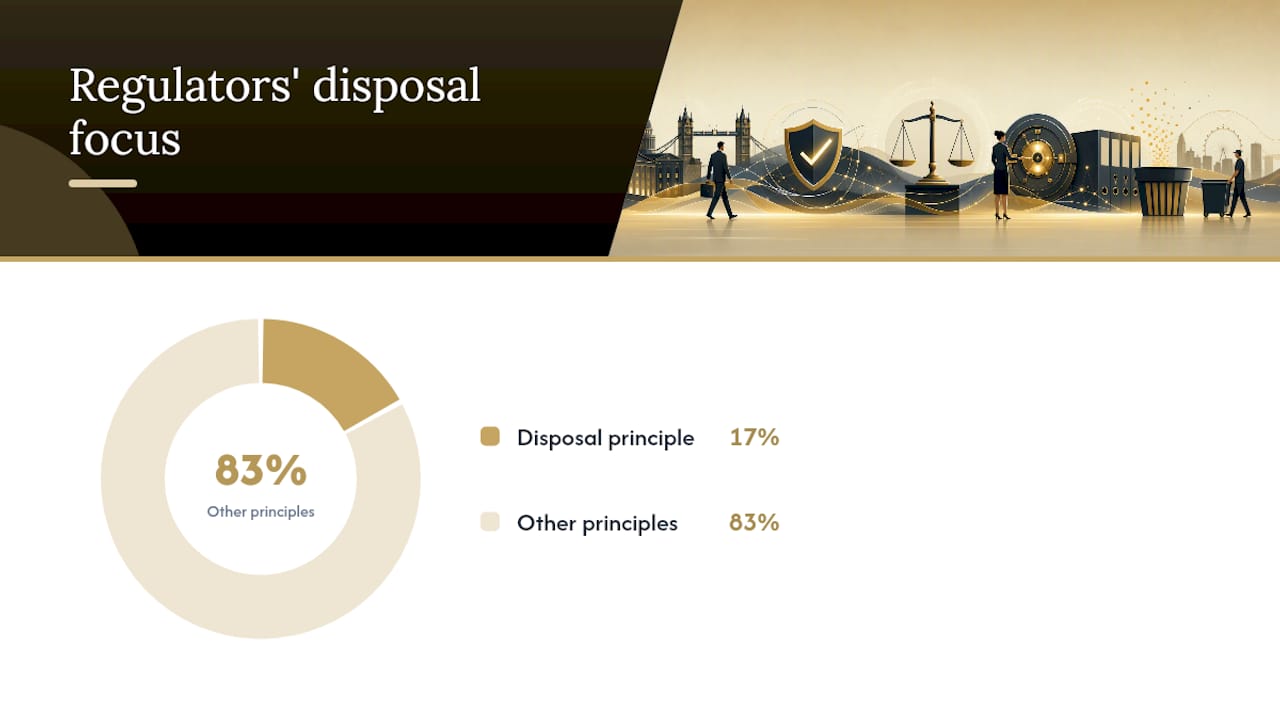
Article 5 of UK GDPR sets the baseline: personal data must not be kept longer than necessary (storage limitation), and it must be processed with appropriate security, integrity, and confidentiality throughout its life, including its destruction. Disposal isn’t an afterthought to compliance. It’s one of the six principles regulators actively check.
The ICO’s guidance on disposal and deletion expects organisations to:
- Destroy paper and electronic records using secure, irreversible methods.
- Put contracts in place with any third-party processor handling destruction on their behalf.
- Log every disposal decision and retain evidence, typically a Certificate of Destruction, that the action actually happened.
Statistic callout: Compliance under UK GDPR isn’t a one-off tick box. It’s an ongoing, auditable state, meaning any processor you use for shredding or data destruction must contractually match the protections you’re required to provide yourself.
Here’s the part firms underestimate: an inspector doesn’t just ask whether you destroyed the files. They ask for proof. If you can’t produce a Certificate of Destruction or a chain-of-custody record, the ICO can treat that gap as non-compliance in its own right, regardless of whether the destruction happened correctly.
What are the best methods for destroying paper legal files?
A desktop strip shredder in the corner of an office feels like it’s doing the job, but it usually isn’t. Strip-cut shredders produce long, uniform ribbons of paper that can be reassembled, sometimes by hand, sometimes with basic scanning software. For anything containing client names, case numbers, or financial details, that’s an unacceptable risk. Professional cross-cut or micro-cut destruction reduces paper to particles small enough that reconstruction becomes virtually impossible, which is the standard the ICO expects for sensitive material.
You’ve got two practical routes for professional destruction:
- On-site (witnessed) shredding. A mobile shredding vehicle attends your premises and destroys the material there, letting a staff member watch the process and receive proof on the spot.
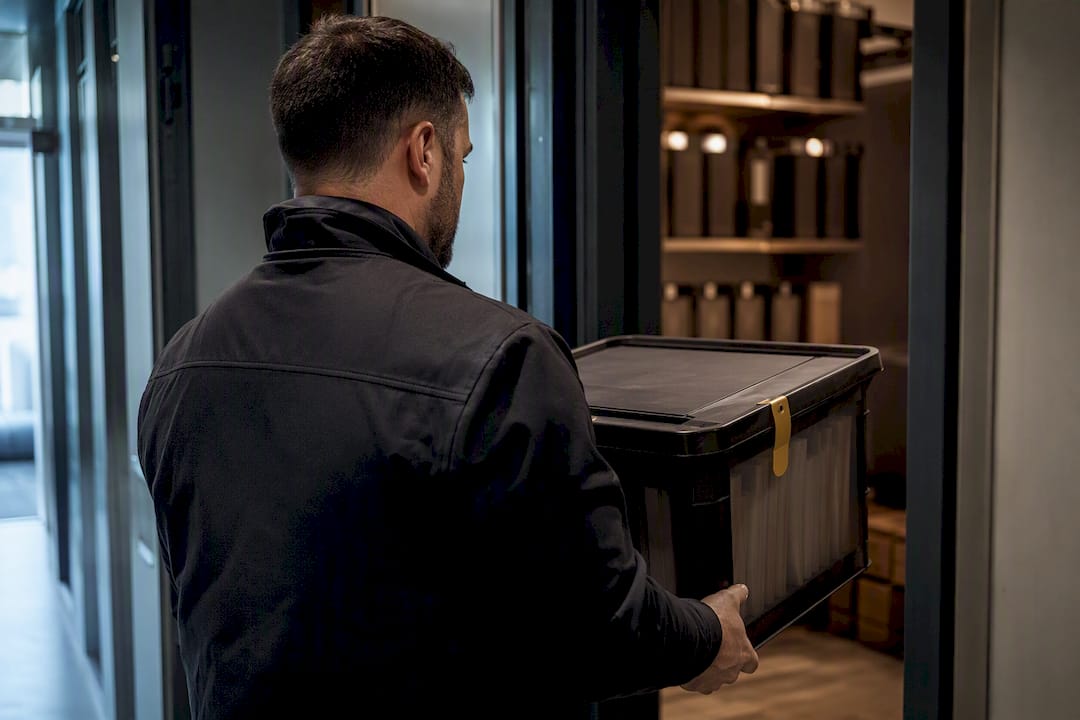
- Off-site shredding with secure transfer. Files are collected in locked containers, transported under tracked conditions, and destroyed at a licensed facility, with the Certificate of Destruction issued afterwards.
Between collection and destruction, lockable bins matter more than most people assume. A cardboard box by the photocopier isn’t secure disposal. It’s an open invitation.
Before booking any provider, check for CCTV and GPS-tracked vehicles, staff vetted to BS7858, a valid Environment Agency waste carrier licence, and confirmation that shredded material is recycled or disposed of at a licensed facility rather than landfill.
Pro Tip: Keep a simple log of collection dates and certificate numbers even if your provider stores this digitally. If a subject access request lands eighteen months later, you’ll want to prove exactly when a specific file was destroyed, not just that “shredding happens regularly.”
How do you securely dispose of digital legal files?
Deleting a file on a laptop doesn’t destroy it. It removes the pointer to the data while the underlying information often sits recoverable on the drive, in temporary files, or in a backup you forgot existed. For legal files held on hard drives, USB sticks, or old case-management servers, this gap between “deleted” and “gone” is where data breaches quietly happen.
The NIST SP 800-88 Rev.2 framework, which UK providers increasingly align to alongside NCSC guidance, defines three tiers: clear (standard overwrite, suitable for low-risk reuse), purge (advanced techniques rendering data infeasible to recover even with lab equipment), and destroy (physical destruction, the only option when purge isn’t verifiable). Which tier applies depends on the device:
- HDDs can usually be securely erased via verified multi-pass overwriting, or physically destroyed where certainty matters more than reuse value.
- SSDs and NVMe drives need controller-level sanitisation, NVMe Sanitize or ATA Secure Erase, because their wear-levelling means a standard overwrite may miss data blocks entirely.
- Devices where sanitisation can’t be verified should go straight to physical destruction, logged by serial number.
Statistic callout: Where a drive cannot be verifiably wiped, physical destruction is the fallback, a principle UCL’s own information security guidance sets out plainly for exactly this reason.
Reputable providers back this with operational controls: asset logging by serial number, sample verification (some run forensic checks on a slice of each batch), and a Certificate of Destruction that names the specific assets destroyed, not a generic statement covering “a quantity of media.”
How do you choose and instruct a compliant destruction provider?
Picking a provider on price alone is how firms end up unable to prove compliance six months later. Work through a short checklist before signing anything:
- Ask for a sample Certificate of Destruction and confirm it includes a chain-of-custody reference number, not just a company letterhead.
- Check Environment Agency waste carrier registration and, for electronics, WEEE compliance, since transporting waste without the right licence is itself an offence.
- Confirm staff vetting standards, ideally BS7858, and ask whether their process references ISO 27001, NCSC, or NIST SP 800-88 Rev.2.
- Check their insurance cover for data breach liability, not just public liability.
Once you’ve chosen a provider, the contract needs a few specific clauses: processor obligations mirroring your own GDPR duties, a right-to-audit clause, clear liability terms if destruction fails to meet standard, and a defined timeline for delivering the Certificate of Destruction, ideally within days, not weeks.
Preparation on your end matters just as much. Segregate legal files from general waste, label containers by matter or client where practical, use locked bins rather than open boxes, and complete an inventory before collection so the numbers reconcile against the certificate afterwards.
Pro Tip: Retain your own metadata logs, which files went into which collection, on what date, under whose sign-off, separately from the provider’s certificate. Two independent records of the same event are far stronger evidence than one, especially if a regulator asks you to reconstruct a disposal decision from years earlier.
If files need redacting before they even reach a collection bin, perhaps a contract has a clause you want to keep on file separately, a tool like FlowPDF’s local redaction feature lets you strip sensitive content from a PDF without it ever leaving your device.
Disposal as a defensible habit, not a one-off task
The failure mode that should worry legal teams most isn’t dramatic. It’s the box of old files sitting in a store cupboard for a decade, forgotten until someone tries to reconstruct what was in it after a data breach or subject access request. Reviewers rarely need to prove malicious intent to fine a firm. They need to prove there was no defensible process.
Building destruction into a recurring retention review, rather than treating it as an annual clear-out panic, is what separates firms that pass audits from firms that scramble. A local, auditable provider removes most of the guesswork from that habit.
— Dan
Secure Shred: compliant disposal for legal files in Cardiff and South Wales
If you’ve read this far, you already know what a compliant disposal process needs: certificates, chain-of-custody, and staff you can trust with confidential material. They build all three into every job, using GPS-tracked vehicles and CCTV-monitored operations, staff vetted to standards, and a recycling policy, so every collection leaves an audit trail your practice can produce on demand.
For a one-off clear-out of closed case files, the on-demand shredding and drop-off service covers everything from a single sack to a lockable wheelie bin’s worth of archive material. Sole practitioners and small firms with a steady flow of confidential paperwork are better served by scheduled shredding for home and small offices, which handles recurring collections without you having to remember to book each one. Digital media, old case-management drives, decommissioned laptops, gets destroyed under the same certificate-backed process. Get a quote or book your first collection through Secure Shred’s Cardiff shredding page today.
Sources
FAQ
How long should a UK law firm keep case files before disposal?
Closed case files typically need retaining for six years after conclusion, longer for cases involving minors, personal injury, or ongoing appeal rights, before secure destruction becomes appropriate.
Is shredding at the office enough for confidential legal documents?
Standard strip-cut office shredders produce reconstructible strips, so they’re not considered adequate for sensitive legal files; cross-cut destruction from a professional provider meets the security standard regulators expect.
What proof should I ask for after a legal-file shredding collection?
Ask for a Certificate of Destruction referencing a chain-of-custody number, confirming what was destroyed, when, and under what method, this is the primary evidence regulators look for during an audit.
Does deleting a file from a computer count as secure disposal?
No. Deletion typically leaves recoverable data on the drive; secure disposal requires verified sanitisation (clear or purge) under NIST SP 800-88 Rev.2 standards, or physical destruction where sanitisation can’t be verified.
How much does secure document shredding cost in Cardiff?
Pricing depends on volume and service type; Secure Shred’s one-off collection and drop-off options start from a few pounds per additional item, with current prices listed on the site.