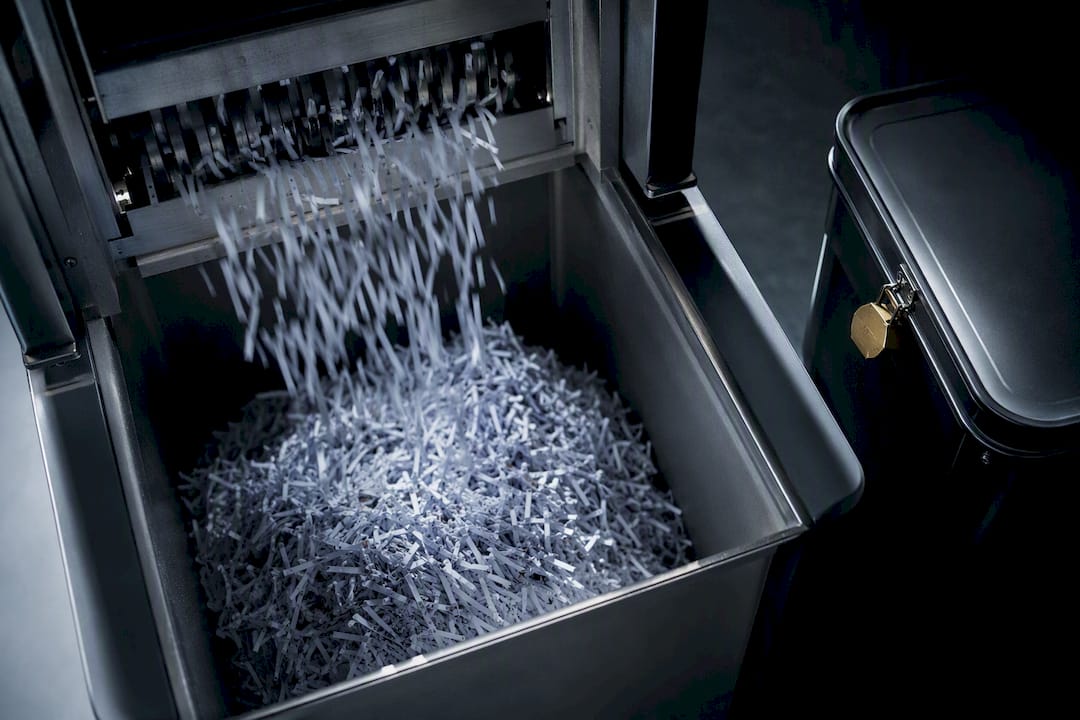
A confidential waste policy in the UK must guarantee that personal and sensitive data is destroyed securely at the end of its life, in line with UK GDPR, the Data Protection Act 2018, and the Section 34 waste duty of care. Before anything goes near a shredder, check your retention schedule and RoPA to confirm the destruction is lawful. Every job should end with a certificate of destruction and a clear chain of custody. Appoint someone to own this process today, and get confidential bins or a collection booked.
TL;DR:
- Ensure destruction processes are lawful by checking retention schedules and RoPA before shredding or deleting any records containing sensitive information.
- Require destruction providers to supply certificates with unique consignment numbers and proof of onsite or witnessed destruction to maintain traceability.
- Use cross-cut shredding or verified small particle destruction for paper waste and physical destruction for electronic media to meet environmental and security standards.
- Appoint a designated policy owner responsible for overseeing confidential waste procedures, staff training, and contractor compliance.
- Regularly audit destruction records, certificates, and contractor credentials to demonstrate ongoing compliance and readiness in case of regulatory inquiries.
Table of Contents
- What counts as confidential waste under UK guidelines
- Legal duties you must meet: UK GDPR, DPA 2018 and Section 34
- Standards and guidance your policy should reference
- Secure destruction methods and what to demand from contractors
- What your confidential waste policy checklist should include
- Who owns confidential waste, and what staff need to know
- Proving compliance: records, audits and retention of evidence
- A short action plan for small businesses
- Why traceability changes everything when something goes wrong
- Book a compliant collection with Secure Shred
- Where to check the rules yourself
- Sources
- FAQ
What counts as confidential waste under UK guidelines
Confidential waste covers any paper or electronic record containing personal, financial, or commercially sensitive information. That includes USB sticks, hard disk drives, backup tapes, and CDs, not just filing cabinets full of paper.
In practice, this means:
- HR files, payroll records, and employee contracts
- Invoices, bank statements, and financial reports
- Meeting packs, board papers, and legal correspondence
- Customer contracts, medical notes, and ID documents
- Redundant hard drives, USB sticks, and backup tapes
If you’re unsure whether something qualifies, treat it as confidential and ask your data protection officer. That default habit costs you nothing and avoids the far more expensive mistake of a document ending up in general recycling.
Legal duties you must meet: UK GDPR, DPA 2018 and Section 34
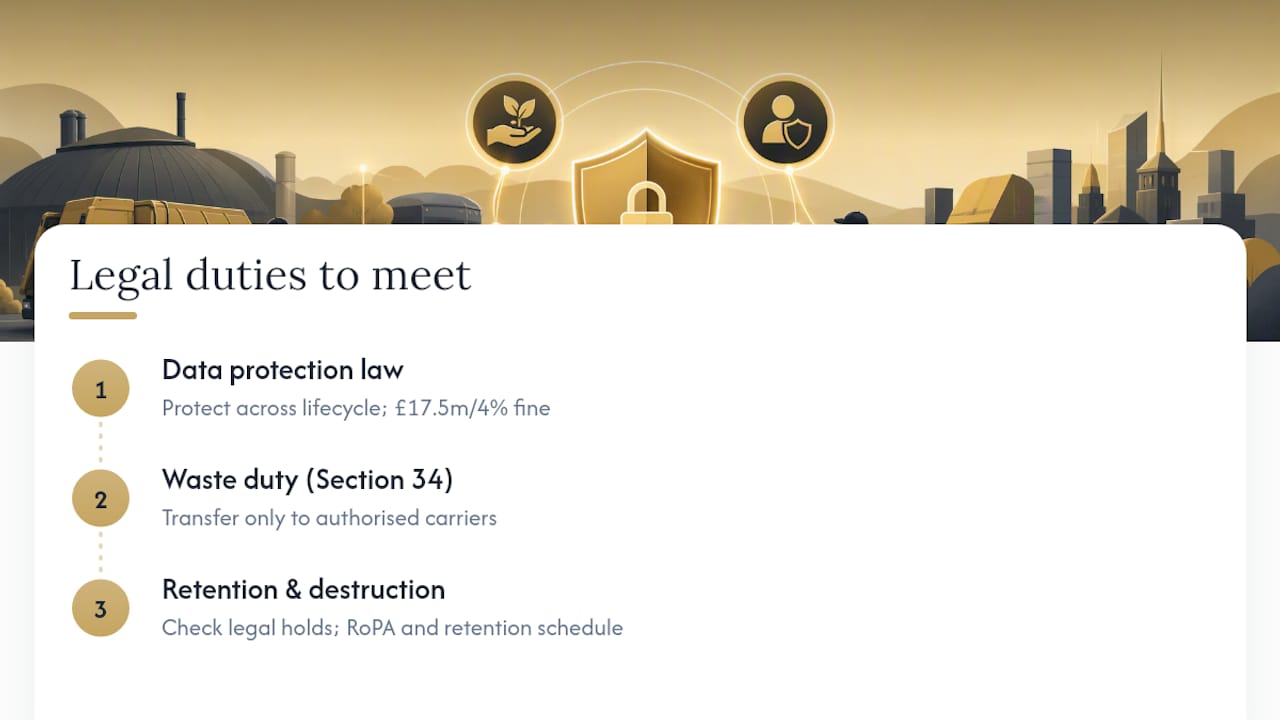
UK GDPR and the Data Protection Act 2018 require organisations to protect personal data across its entire lifecycle, and disposal is very much part of that lifecycle, not an afterthought once the “real” compliance work is done. Get it wrong and the maximum fine under UK GDPR and DPA 2018 reaches £17.5 million or 4% of global annual turnover, whichever is higher.
Separately, the Section 34 waste duty of care applies to the physical handling of your waste, confidential or not. It requires you to ensure waste is transferred only to authorised carriers and handled responsibly at every stage, which is exactly why the Gov puts so much weight on checking a contractor’s credentials before you hand anything over.
There’s a less obvious trap here too. Destroying records too early can itself be a breach if a legal hold, Freedom of Information request, or ongoing investigation applies. The ICO’s guidance on retention and destruction is blunt on this point: check before you shred, not after. Build a retention schedule and RoPA check into your destruction procedure as a fixed step, not an optional one.
Standards and guidance your policy should reference
A credible confidential waste policy cites recognised standards rather than vague promises of “secure disposal.” BS EN 15713 is the benchmark standard for secure destruction of confidential material, covering everything from container security to staff vetting, and any contractor worth hiring should be able to speak to it fluently.
For electronic media, the NCSC’s guidance on sanitisation sets out when overwriting or crypto-erasure is sufficient and when physical destruction is required instead. High-sensitivity drives generally need destruction verified down to small particle sizes rather than a simple wipe.
Shredding electronic storage media also triggers environmental rules. Environment Agency RPS 309 sets conditions for this activity, including a storage limit of up to 5 tonnes in a 12-month period and a requirement to send shredded POPs waste for irreversible destruction. On top of that, the ICO’s retention and disposal guidance expects organisations to check retention schedules against RoPA entries before anything is destroyed.
Between them, these standards answer the question most policies dodge: not just “how do we destroy this,” but “how do we prove we did it properly.”
Secure destruction methods and what to demand from contractors
Paper waste should go through cross-cut shredding as a baseline, with disintegration or pulping reserved for your most sensitive material, such as unredacted medical or legal files. Electronic media takes more judgement: sanitisation through overwriting or crypto-erasure works fine when a drive will be reused, but physical destruction to verified small particle sizes is the safer route for anything leaving your building for good, as NCSC guidance sets out. Degaussing has limits too. It can work on older magnetic media but doesn’t reliably sanitise modern solid state drives, so don’t rely on it as a universal fix.
Before signing with any destruction provider, run through this checklist:
- Do they provide a certificate of destruction for every consignment?
- Can they demonstrate witnessed or on-site destruction if you need it?
- Do their vehicles carry GPS tracking and CCTV for chain of custody?
- Can they show insurance and evidence of environmental compliance under RPS 309?
- Do they explain limits on storage duration and how they handle WEEE or POPs waste?
Pro Tip: Ask for a sample certificate of destruction before you sign anything. If it doesn’t carry a unique consignment number, a date, and a description of the material destroyed, it isn’t worth the paper it’s printed on.
What your confidential waste policy checklist should include
A working policy needs more than good intentions. It needs clauses your staff can actually follow on a Tuesday afternoon without ringing the compliance team.
At minimum, include:
- A clear scope defining what counts as confidential waste, paper and digital
- A mandatory retention and RoPA check, plus a legal hold check, before any destruction
- Labelling and locked storage requirements for confidential bins and cabinets
- Transfer controls: locked containers, escorted transport, and a short list of named keyholders
- Contractor procurement standards, including certificates, insurance, and audit rights
- A destruction log recording chain of custody for every consignment
Several council confidential waste policies, including North Kesteven District Council’s, build in exactly these operational controls, particularly around escorted transfers and limited keyholders, and they’re a useful template even for a small business writing its first version.
Who owns confidential waste, and what staff need to know
Every policy needs a named owner, usually your Information Asset Owner or data protection officer, who signs off on procedures and contractor choices. Day-to-day, individual staff carry the duty to check RoPA before binning anything borderline, use the secure containers provided, and never carry confidential material off-site informally.
Facilities staff need clear rules on key control for locked bins and cabinets. Run refresher training at least annually, and make sure everyone knows exactly who to tell if a confidential document goes missing or turns up somewhere it shouldn’t.
Proving compliance: records, audits and retention of evidence
Regulators and auditors don’t take your word for it, they want paper trails. Keep certificates of destruction, consignment notes, chain of custody logs, and the RoPA entries that justified each disposal decision.
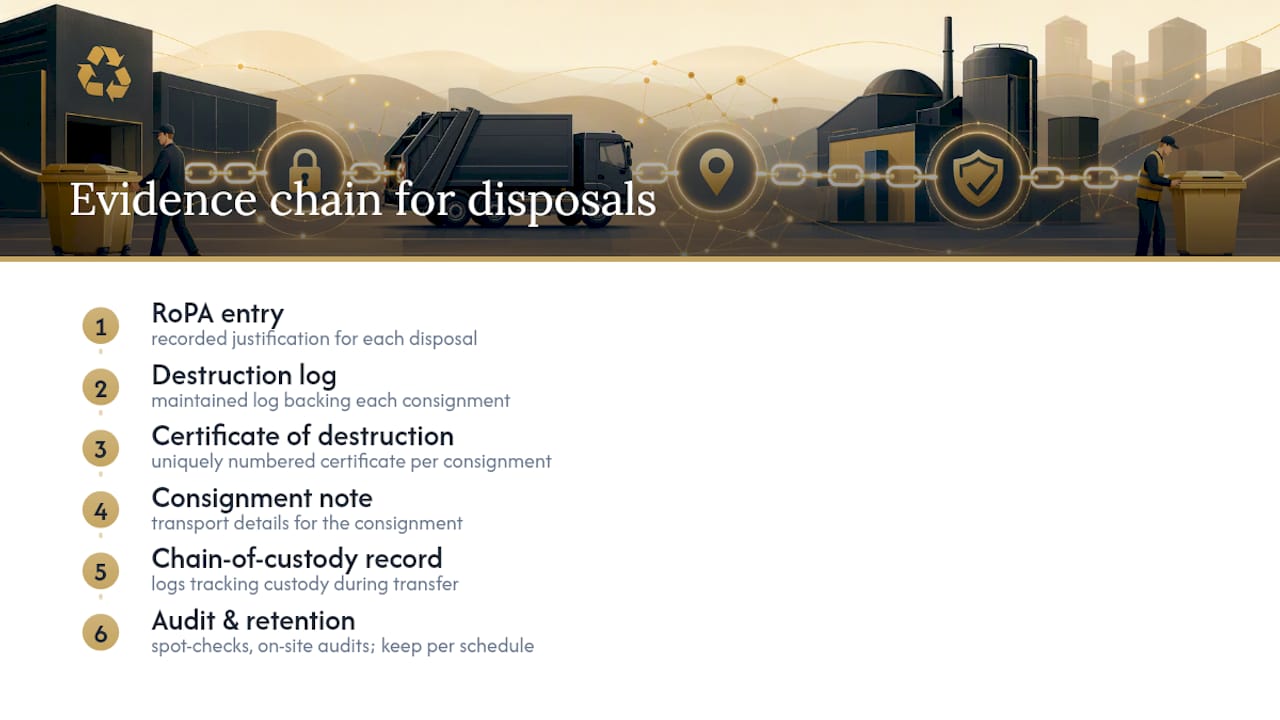
Audit this regularly: spot-check certificates against your destruction log, do occasional on-site checks of a contractor’s process, and confirm their accreditation and environmental compliance haven’t lapsed. A uniquely numbered certificate for every consignment, backed by a maintained destruction log, is the practitioner standard worth holding contractors to. Keep these records for as long as your retention schedule requires, since they’re often the first thing an ICO investigation asks for.
A short action plan for small businesses
If you’re starting from nothing, this order works:
- Map your RoPA and identify what confidential waste you actually generate
- Appoint a policy owner and get secure bins or a one-off collection booked
- Ask any provider for witnessed destruction, a certificate, and evidence of GPS/CCTV tracking
- Brief staff, review your contractor agreement, and schedule an annual audit
Small businesses that skip step one usually end up destroying the wrong thing at the wrong time, which is a worse outcome than doing nothing at all.
Why traceability changes everything when something goes wrong
A confidential waste incident isn’t hypothetical for most businesses, it’s a matter of when. When it happens, a certificate of destruction and a documented chain of custody are what separate a five-minute conversation with the ICO from a formal investigation. Traceable collections, like those Secure Shred provides through GPS-tracked vehicles, turn a vague promise into evidence you can actually produce.
— Dan
Book a compliant collection with Secure Shred
A local shredding service can provide a direct route to compliant destruction, avoiding paperwork gaps common in policies based on good intentions alone. Every job, from a one-off sack collection to a scheduled business contract, should include GPS-tracked vehicles, CCTV monitoring, and a certificate of destruction suitable for compliance records.
Before you book with anyone, ask three questions: will they issue a certificate, can they show GPS and CCTV coverage, and do they handle electronic media in line with environmental rules. If you need a one-off clear-out, the one-off collection and ad-hoc shredding service covers everything from a single sack to a lockable wheelie bin of archive material. For ongoing needs, the home and small office shredding page sets out scheduled collections that keep your confidential waste policy running without you having to think about it week to week. Businesses building larger contracts can also review Business Packages and on-site or off-site destruction for a solution matched to volume rather than guesswork.
Where to check the rules yourself
- ICO: fines, retention guidance, and enforcement precedent
- NCSC: sanitisation standards for electronic media
- Environment Agency RPS 309: permit conditions for shredding
- Gov: contractor and disposal obligations
- Chief Legal Office: practical data security procedures for policy drafting
Sources
FAQ
What is classed as confidential waste?
Confidential waste is any paper or electronic record containing personal, financial, or sensitive business information, from HR files and invoices to USB sticks and hard drives. If a document or device could identify a person or expose commercial detail, treat it as confidential rather than general waste.
How do you dispose of confidential documents in the UK?
You dispose of confidential documents by cross-cut shredding, disintegration, or pulping through a contractor who meets the Section 34 waste duty of care and can prove it. Always request a certificate of destruction and confirm your retention schedule and RoPA allow disposal first.
What are the new waste rules in the UK for electronic media?
Environment Agency RPS 309 sets conditions for shredding electronic storage media, including a storage limit of up to 5 tonnes in any 12 month period and rules for handling POPs waste irreversibly. Contractors handling your hard drives or tapes should be able to confirm they operate within these conditions.
How much does confidential waste shredding cost?
Costs vary by volume and collection type, so there’s no single figure that applies across the market. Secure Shred’s one-off collection service lists sack based pricing and lockable wheelie bin options directly on its site, with current prices available there for exact quotes.