

Bulk shredding in the UK typically costs between £5 and £10 per sack or archive box, with one-off collection minimums usually landing between £65 and £85, though very large clearances move to pallet or per-tonne pricing. Your final figure depends on volume, whether you want on-site or off-site destruction, and how easy your premises are to access. Get an itemised quote before you commit, and treat a provider which tailors pricing to your exact job as your first call.
TL;DR:
- Prices drop from around £10 to £5 per sack as volume increases, with larger clearance jobs typically billed per pallet or tonne.
- One-off collection minimums usually range between £65 and £85, with potential surcharges for difficult access or out-of-zone locations.
- Accurate quotes require detailed information on volume, access, security needs, and itemized costs to prevent unexpected charges.
- Regular scheduled collections and pre-sorting waste can significantly reduce total bulk shredding costs.
- Most jobs are completed within a week to ten days, with destruction typically done within 24 to 48 hours after collection.
Table of Contents
- How much does bulk shredding cost per sack, box or collection?
- What makes one shredding quote higher than another?
- How do you get an accurate bulk shredding quote?
- How can you cut the cost of bulk shredding?
- How Secure-shred prices and handles bulk collections
- How long does bulk shredding take from booking to certificate?
- What hidden fees catch people out in shredding contracts?
- Should you outsource bulk shredding or handle it yourself?
- How to get a tailored Secure-shred quote
- Sources
How much does bulk shredding cost per sack, box or collection?
Most UK shredding providers price their bulk work in one of three ways, and knowing which model applies to your job makes comparing quotes far easier.
Per-sack and per-box pricing suits smaller bulk jobs, typically anything from a handful of sacks up to a van load. Industry pricing guides put standard per-sack rates in the region of £5 to £10, with the price per sack dropping as your volume increases. A single sack from a home office clear-out sits at the top of that range; a business disposing of forty or fifty sacks in one go usually pays nearer the bottom.
Per-collection pricing applies once you’re booking a dedicated visit rather than a top-up sack collection. One-off, off-site collection minimums commonly fall between £65 and £85 per collection, covering the call-out and a set volume allowance, with additional sacks or boxes charged on top. Some local providers publish sharper entry rates, with sack prices closer to £4.50 to £5 and separate minimum charges for warehouse-style jobs, so it always pays to ask for the exact breakdown rather than assuming a headline figure applies to you.
For archive clearances running into hundreds of boxes, pricing usually shifts to a pallet, skip, or per-tonne basis, since the job is really a logistics exercise rather than a simple collection.
A standard quote should include:
- Collection and transport to the shredding facility or on-site destruction
- A certificate of destruction confirming the material has been securely destroyed
- Recycling of the shredded paper waste
Watch for VAT, which is usually added separately, and transport surcharges for locations outside a provider’s core coverage area.
What makes one shredding quote higher than another?
Two businesses with what looks like an identical job can receive very different quotes, and the gap almost always comes down to five factors.
Volume is the biggest lever. Providers build in bulk discounts once you cross certain thresholds, typically around 10, 25, and 50+ sacks, because larger loads make better use of vehicle space and staff time.
Service type matters just as much. On-site, mobile shredding, where a truck-mounted shredder destroys your documents in your car park while you watch, typically costs more than off-site collection, because it needs a specialised vehicle and a technician’s time dedicated entirely to your job.
Other drivers include:
- Access and labour: stairs, no lift, long carries to the vehicle, or restricted parking all add handling time and cost
- Location: rural or out-of-zone addresses often carry a mileage surcharge, while urban clients closer to a provider’s base tend to pay standard rates
- Material type: lever-arch binders, ring binders, and mixed media like hard drives usually attract a per-unit charge on top of standard paper rates, and contaminated loads (plastics, food waste mixed in) can trigger a handling penalty
Pro Tip: Failing to mention access limitations at the quote stage is the single most common reason for day-of surcharges. Tell your supplier about stairs, lift availability, and parking before they arrive, not when the van shows up.
How do you get an accurate bulk shredding quote?
Vague quote requests get vague quotes back, and vague quotes have a habit of growing once the van arrives. Give a supplier this before they price your job:
- Volume details: the number and size of sacks, archive boxes, or pallets you need cleared
- Access information: which floor the material sits on, whether there’s a lift, and how far it is from the building to the vehicle or parking bay
- Security requirements: whether you need witnessed on-site destruction or standard off-site shredding with a certificate afterwards
- Itemised pricing: the minimum fee, unit price per sack or box, transport charge, disposal fee, and VAT, listed separately rather than bundled
- Timing and terms: expected lead time from booking to collection, and the cancellation policy if your dates shift
Once you have that itemised breakdown, hold it against the checklist above before booking. A quote that hides the unit price inside a single “all-in” figure is much harder to compare against a competitor’s, and it’s usually the one hiding the highest margin.
How can you cut the cost of bulk shredding?
You don’t need to compromise on security to bring your shredding bill down, and most of the savings come from planning rather than negotiating.
Scheduled, regular collections usually cost less per unit than repeated one-off clearances, because suppliers can plan routes and fill vehicles more efficiently instead of sending a van out for a single small job. Consolidating several small purges into one bulk collection has the same effect: fewer call-outs, lower total cost.
Beyond that:
- Pre-sort your waste to strip out non-confidential material before collection, cutting the volume you’re paying to destroy
- Use the provider’s standard sacks or boxes rather than mixed containers, which speeds up loading and reduces handling time
- Reserve on-site witnessed destruction for genuinely sensitive material, and use off-site shredding for routine archive clearance where a certificate of destruction is sufficient assurance
Pro Tip: If you’re clearing an archive that’s built up over several years, ask about a one-off bulk rate rather than booking it as several smaller jobs. The unit price usually drops once you’re past the first few hundred items.
How Secure-shred prices and handles bulk collections
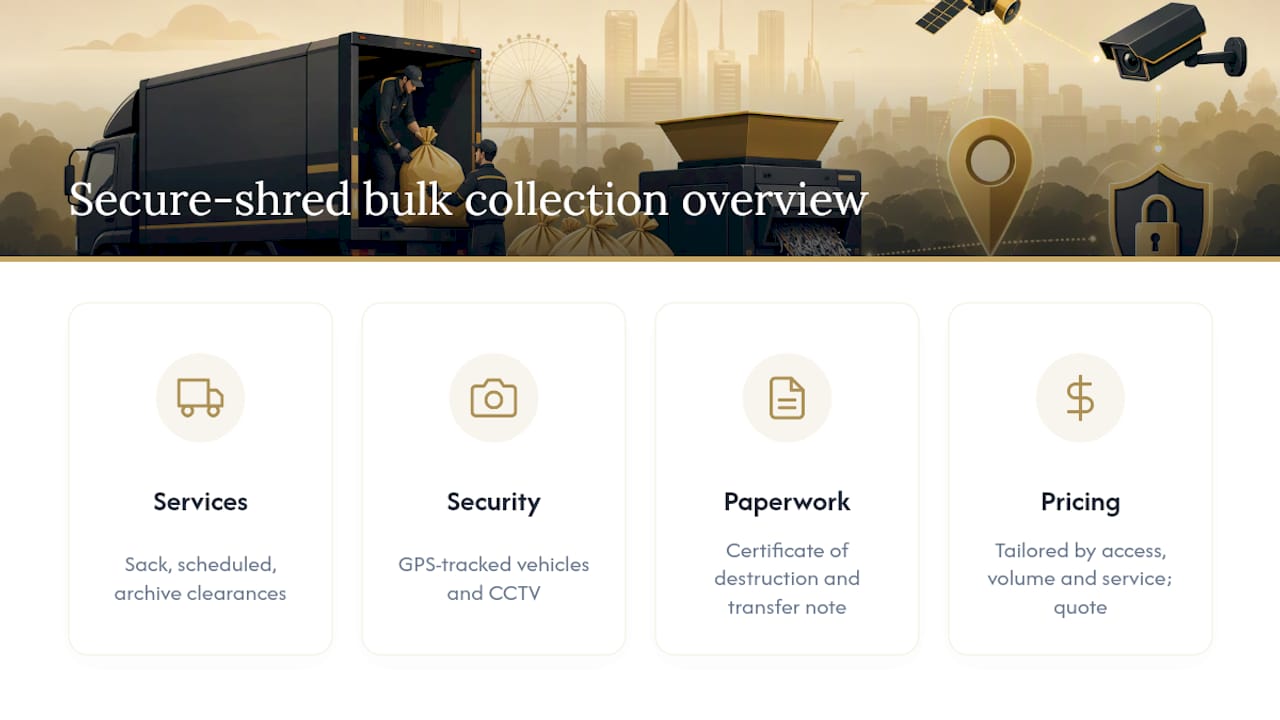
Secure-shred runs bulk destruction for homes and small to medium businesses across Cardiff and South Wales, covering pay-as-you-go sack shredding, scheduled collections, and full archive box clearances. Every job uses GPS-tracked vehicles and CCTV monitoring, so there’s a clear chain of custody from the moment your documents are collected to the moment they’re destroyed, and staff are vetted before they ever handle client material.
Clients receive a certificate of destruction and a waste transfer note for every job, giving you the paper trail needed to demonstrate GDPR compliance if a client, auditor, or regulator ever asks how you handled a data disposal. Pricing is tailored to access, volume, and required service level rather than fixed to a single rate card, so the fastest route to an accurate figure is a direct quote rather than a generic price list.
How long does bulk shredding take from booking to certificate?
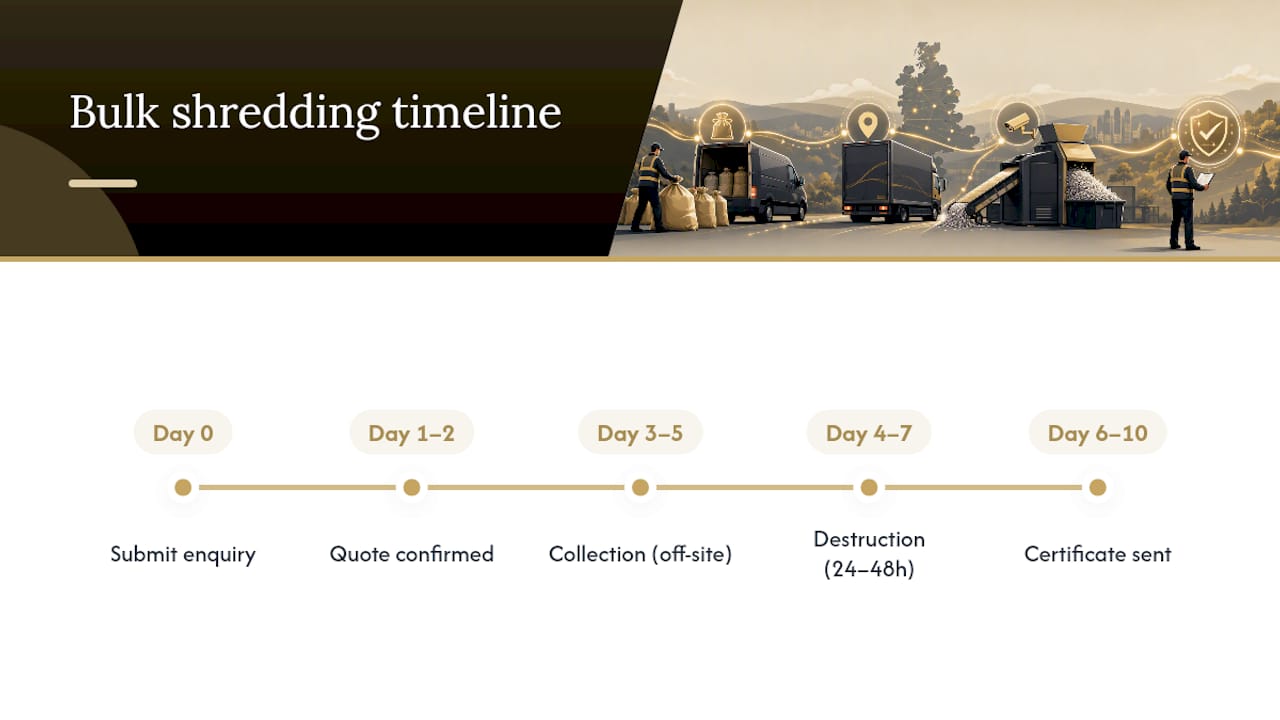
Most UK bulk shredding jobs run from initial enquiry to certificate delivery within a week to ten days, though the exact timeline depends on your provider’s schedule and how urgently you need collection.
A typical sequence looks like this: you submit your volume and access details, the provider confirms a quote, usually within a day or two, and you book a collection slot. Off-site jobs are often collected within three to five working days of confirmation, while on-site mobile shredding may need slightly longer notice to schedule the specialist vehicle.
Destruction itself, whether on-site or at a secure facility, typically happens within 24 to 48 hours of collection. The certificate of destruction usually follows within a few working days after that, either by post or email depending on the provider.
If you’re working to a hard deadline, such as an office move or a compliance audit, tell your supplier at the outset. Providers can often prioritise urgent jobs, but that usually carries a premium, so it’s worth building in a buffer of a week or two where your schedule allows it. For very large archive clearances spanning hundreds of boxes, the collection phase alone might stretch across multiple visits, which extends the overall timeline even if each individual collection runs smoothly.
What hidden fees catch people out in shredding contracts?
The headline price rarely tells the whole story, and most complaints about shredding costs come from charges that weren’t obvious at quote stage rather than the base rate itself.
Common extras to check for before signing anything:
- Fuel or mileage surcharges for addresses outside a provider’s standard coverage zone
- Access charges applied on the day if stairs, lifts, or long carries weren’t declared upfront
- Contamination fees if your waste contains plastics, food packaging, or other non-paper material mixed in with documents
- Minimum charge shortfalls, where a smaller-than-expected load still triggers the full minimum fee
- Rescheduling or cancellation fees if you need to move a booked collection at short notice
- VAT, which some headline prices exclude and only add at invoice stage
None of these are unreasonable in themselves, but they should appear in writing before collection day, not as a surprise line on your invoice. A supplier confident in its pricing will happily itemise every potential extra charge when you ask, and that willingness to be upfront is often a better signal of trustworthiness than the headline rate alone.
Should you outsource bulk shredding or handle it yourself?
Outsourcing wins for anything beyond a handful of bags. A supplier clears hundreds of boxes in hours, hands you an audit trail, and frees your staff for paid work. DIY looks cheaper until you count staff hours, a shredder that can’t cope with volume, and the cost of secure disposal afterwards. For most UK SMEs and homeowners, a professional quote beats guesswork on both time and risk.
— Dan
How to get a tailored Secure-shred quote
A shredding service prices bulk jobs around your actual situation rather than a one-size rate card, so the fastest way to a real number is providing your volume, access, and preferred service level. That means the number and size of sacks or boxes, whether you’re on the ground floor or up several flights, and whether you need witnessed on-site destruction or standard off-site collection with a certificate of destruction afterwards.
You can start with a quick quote for a fast estimate, arrange a drop-off for smaller loads, or set up scheduled collections if your archive clear-out is ongoing rather than one-off. Every job, whatever the size, comes with a certificate of destruction and the recycling and security measures covered earlier in this guide, and Secure-shred covers Cardiff and the surrounding South Wales area including Cwmbran. If your bulk clearance is business-related, browse the full range of shredding services or, if you’re clearing a smaller home office alongside a larger job, check the home office shredding option for a lower-volume price point. Businesses in sectors like construction, where paperwork volumes build up fast alongside site admin handled through tools such as TradeTally, often find a scheduled contract works out cheaper than repeated one-off calls. Submit your details through the quick-quote form and you’ll have an itemised, tailored price back without committing to anything.