
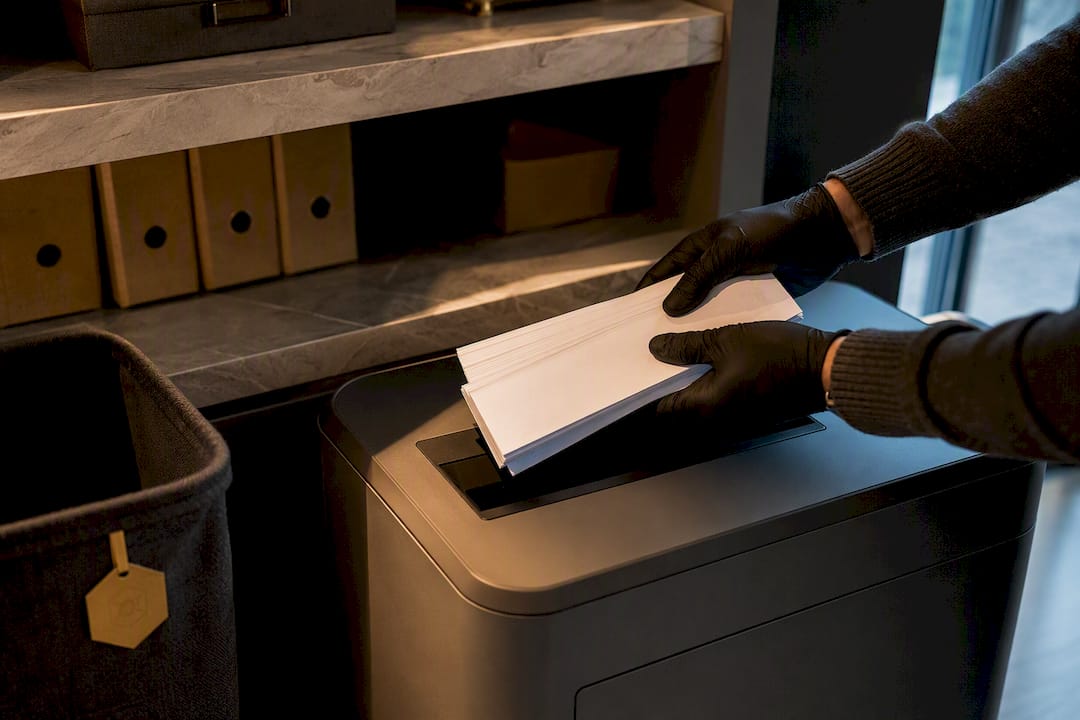
Shred your old bank statements or book a certified destruction service. Keep only what HMRC or a specific purpose (mortgage, warranty, dispute) requires, and destroy the rest securely. The ICO’s storage-limitation principle is clear on this: if you no longer need it, you shouldn’t be keeping it in a drawer where anyone can find it.
TL;DR:
- Shredding documents with a cross-cut shredder at DIN P-4 or higher provides the most secure destruction for financial statements, preventing reassembly.
- Keep statements for at least 22 months, with longer retention only necessary if related to ongoing disputes, mortgages, or warranties.
- Using professional shredding services with certificates of destruction is advisable for large archives, hard drives, or estate clear-outs to ensure chain-of-custody security.
- Digitally stored copies should be encrypted, deleted securely after use, and created before closing accounts to avoid losing essential records.
- Do not recycle whole statements unshredded, as they remain readable and vulnerable, and never hoard outdated documents beyond their necessary retention period.
Table of Contents
- Quick checklist: gather, sort and decide
- Practical methods for destroying paper documents
- What if you don’t have a shredder at home?
- How long to keep bank statements and what to retain
- When to use a professional shredding service
- Digital copies, account closure and preserving evidence
- If your statements are misused: immediate response steps
- Why most advice on this gets the priority wrong
- Book a collection with Secure-shred
- Sources
Quick checklist: gather, sort and decide
Before anything goes near a shredder, get organised. A messy pile of paperwork is how important documents end up in the recycling bin by mistake.
- Collect everything. Pull statements from every drawer, folder, and old handbag pocket.
- Sort into two piles. “Keep” (recent statements, anything tied to an open dispute or claim) and “destroy” (everything past its useful life).
- Check the dates twice. Statements from the last 12 to 22 months often still matter for tax or account queries, depending on the relevant tax year and submission timing.
- Move destroy-pile paper safely. Use a locked sack or sealed box if it’s leaving the house for a collection.
Cost-wise, a decent domestic cross-cut shredder ranges from affordable entry-level models to more expensive ones built to handle daily use. If you’ve got boxes rather than a folder’s worth, a one-off collection from a service like Secure-shred usually works out cheaper than the time and wear on a home machine.
Practical methods for destroying paper documents
Not all destruction methods are equal, and the wrong one leaves your account numbers and signature perfectly readable in a bin bag.
- Cross-cut shredding (DIN P-4 or finer). This is the method the ICO points to for good reason: a cross-cut shredder cuts paper into small confetti-like pieces rather than long strips, and DIN P-4 or higher is the level generally recommended for financial documents. Strip-cut shredders are weaker. The strands can be reassembled, which defeats the point.
- Hand tearing or scissors. Fine for the odd statement, but slow and inconsistent for a full archive. Account numbers and sort codes often survive intact in the larger fragments.
- Pulping or soaking. Effective for small batches at home, turning paper to mush in water, but impractical at volume and messy to dispose of afterwards.
- Controlled incineration. Rarely appropriate for individuals in the UK, given local burning restrictions and air-quality rules. Leave this one to licensed facilities.
Pro Tip: Once shredded, mix the paper with other recycling before it goes out. A single bag of your own confetti-cut statements is still, technically, reconstructable with enough patience. Mixed with junk mail and cereal boxes, it isn’t worth anyone’s time.
What if you don’t have a shredder at home?
You don’t need to own a shredder to destroy documents properly. Several routes work just as well.
- Tear then soak. Rip statements into quarters, then soak them in water for a few hours before binning the pulp.
- Community shredding days. Local councils and some charities run occasional free shredding events. Worth checking your council’s website before a big clear-out.
- Commercial drop-off points. Many shredding firms accept walk-in bags for a fixed fee, no appointment needed.
- Paid pay-as-you-go sacks or a one-off collection. Fill a sealed sack and have it collected, with a certificate of destruction issued afterwards.
What you should never do is bin statements whole or toss them straight into ordinary recycling. Council recycling isn’t sorted for privacy. Whole, readable statements can sit in a truck or sorting facility for hours before they’re pulped, and that’s a long window for anyone determined to look.
How long to keep bank statements and what to retain
HMRC’s rule for most individuals is to keep personal tax records for at least 22 months after the end of the tax year they relate to. Businesses face a longer retention period because HMRC can query historic accounts further back.
Here’s where a persistent myth trips people up. Many assume everyone must hold onto six years of statements “just in case.” Martin Lewis and MoneySavingExpert have pushed back on this: the six-year figure applies mainly to businesses and self-employed records, not the average PAYE employee’s personal statements.
For most people, retention breaks down like this:
- Payslips and P60s tied to a tax return: 22 months minimum
- Statements linked to an ongoing mortgage, warranty, or dispute: keep until resolved
- Routine monthly statements with nothing outstanding: destroy once reviewed, often within a year or two
The ICO’s storage-limitation principle reframes the whole question usefully: don’t ask “how long can I keep this?” Ask “do I still need it?” If the answer is no, scan a digital copy for the record and destroy the paper.
When to use a professional shredding service
Doing it yourself makes sense for a handful of statements. It stops making sense once you’re facing an archive clear-out, a deceased relative’s paperwork, or a mix of paper and old hard drives that a home shredder simply can’t touch.
- Volume tips the balance. Boxes rather than folders usually cost less to outsource than the hours spent feeding a domestic machine.
- Mixed media needs specialist handling. Hard drives, USB sticks, and old laptops require destruction methods a paper shredder can’t provide.
- Ask for proof, not just a promise. A certificate of destruction with a visible chain of custody, labelled sacks, sealed vehicles, and GPS-tracked collections, is the real trust signal here, far more meaningful than a company simply saying “we’re secure.”
- On-site versus off-site. On-site shredding lets you watch your documents destroyed at the kerb; off-site relies on sealed transport and facility security instead.
Pricing usually runs per sack, per box, or per collection, with recurring plans working out cheaper per visit than one-off jobs.
Pro Tip: If a provider can’t produce a certificate of destruction on request, that’s your answer. Walk away and find one that can.
Digital copies, account closure and preserving evidence
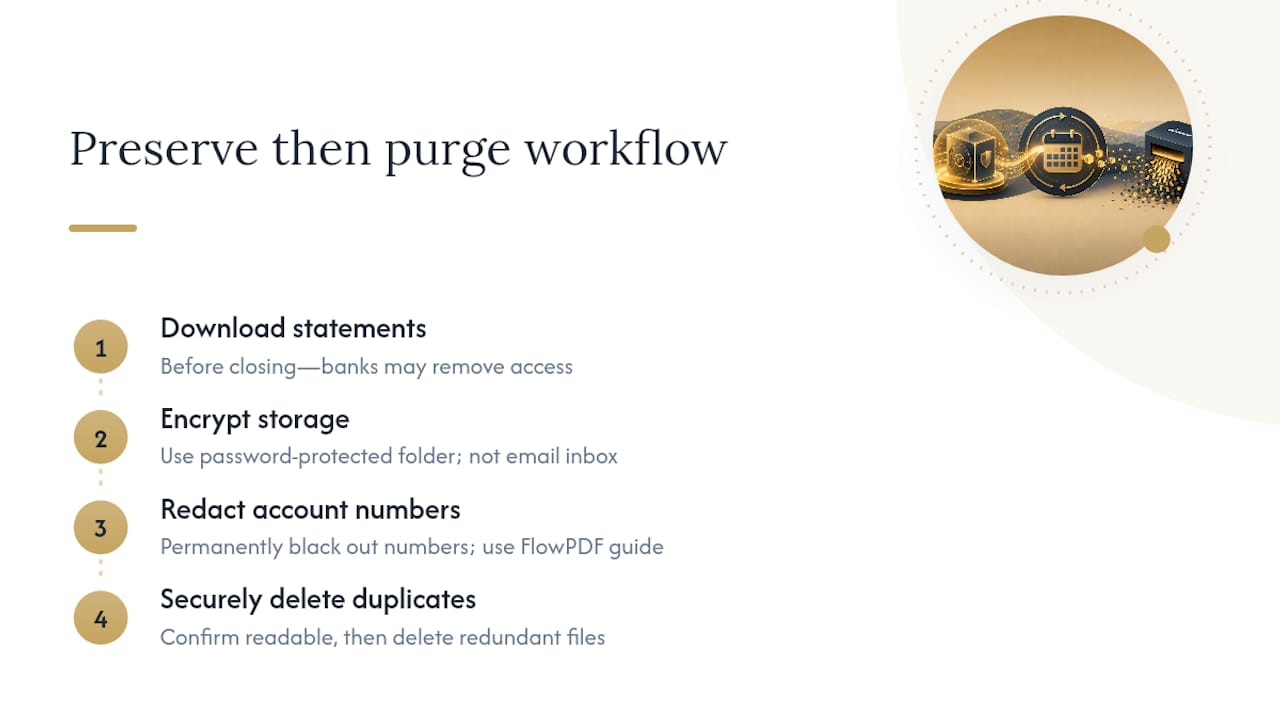
Before you shred anything or close an account, download what you’ll actually need later. Banks routinely restrict or remove online access once an account is closed, sometimes within weeks, so grabbing PDFs of key statements and any loan or mortgage agreements first is worth the ten minutes it takes.
Store those digital copies encrypted, ideally in a password-protected folder or a dedicated secure storage app, not loose in an email inbox. If a statement needs redacting before it’s shared with a third party, a tool like FlowPDF’s redaction guide covers how to black out account numbers permanently rather than just visually. Once you’ve confirmed the digital copy is safe and readable, delete the redundant file securely rather than leaving duplicates scattered across devices.
If your statements are misused: immediate response steps
Suspect a statement has fallen into the wrong hands, or noticed unfamiliar activity? Move fast.
- Contact your bank immediately to freeze the account and flag suspected fraud.
- Report it to Action Fraud, the UK’s national fraud reporting service.
- Check your credit file with one of the major credit reference agencies for new applications you don’t recognise.
- Change passwords on banking and email accounts, and turn on two-factor authentication where you haven’t already.
- Keep a written record of every call, reference number, and email in case you need it for a dispute later.
For anything beyond a single fraudulent transaction, guidance on blocking identity theft attempts or a solicitor’s advice may be worth the cost if the fraud runs deep.
Why most advice on this gets the priority wrong
Most guides on this topic lead with the shredder and treat the legal side as a footnote. That’s backwards. The genuinely useful question isn’t “which shredder should I buy?” It’s “what am I actually required to keep, and for how long?” Get that right first, and the destruction method becomes the easy part.
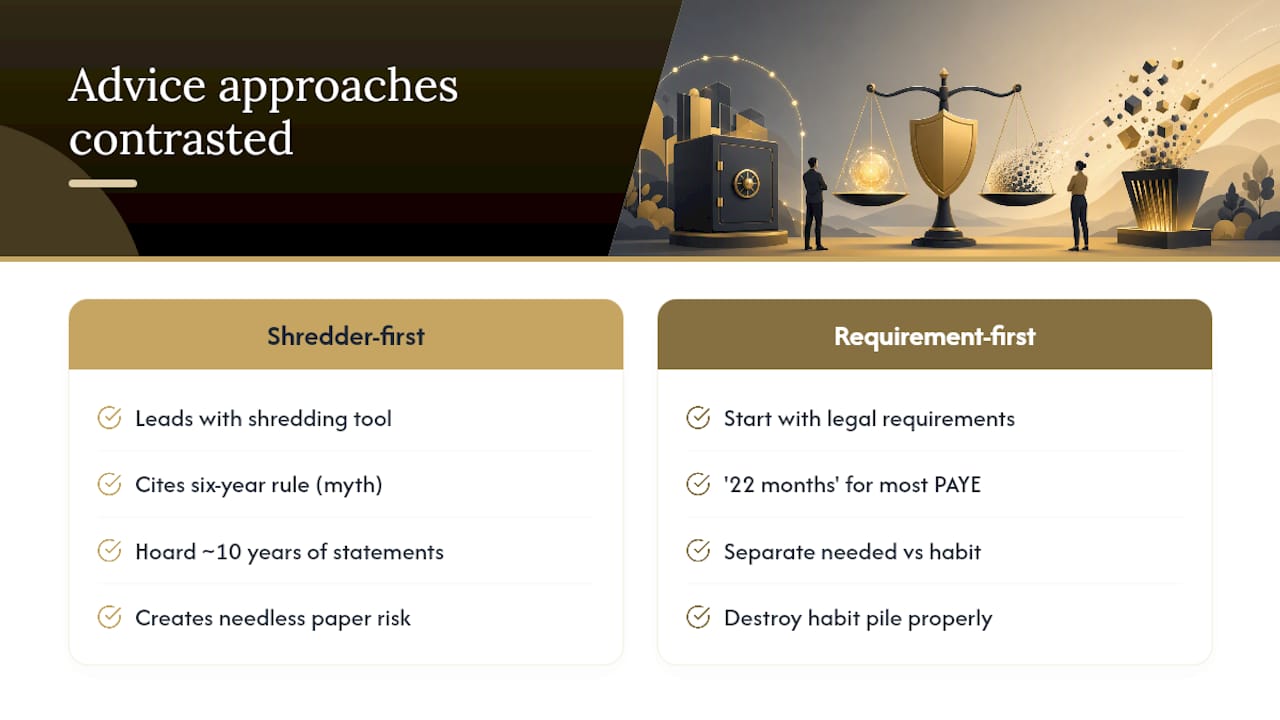
The six-year myth is the clearest example of advice doing readers a disservice. People hoard a decade of statements because someone once said “keep everything for six years,” when for most PAYE employees the real HMRC figure is 22 months. That hoarding isn’t caution. It’s just more paper sitting around, waiting to be a problem if a bag goes missing or a drawer gets cleared out by someone who doesn’t know what’s in it.
If there’s one thing worth prioritising, it’s this: separate “documents I need” from “documents I’ve kept out of habit,” then destroy the second pile properly. A cross-cut shredder handles the average household’s job. Anything beyond that, a full archive, old hard drives, a relative’s estate, is exactly where a certified service with a proper chain of custody earns its cost.
— Dan
Book a collection with Secure-shred
A shredding service can be the practical next step once you’ve decided what needs destroying and don’t fancy standing over a shredder for an afternoon. Such services often cover one-off collections and recurring scheduled visits, pay-as-you-go sacks for smaller jobs, and full archive clear-outs for bigger ones, sometimes with GPS-tracked vehicles and CCTV monitoring for added security.
Many shredding services provide a certificate of destruction, giving you documented proof the job was done, which can be useful for businesses needing evidence for compliance or for peace of mind. Booking works whether you’ve got a single sack or several boxes from a house clearance. If you’re in South Wales and ready to clear that drawer, book a one-off collection in Cardiff or check one-off collection options for larger archive jobs.
Sources
For the legal detail behind this guide, start with GOV.UK’s HMRC retention rules, the ICO’s guidance on destroying documents, the CIPD factsheet on HR record retention, and MoneySavingExpert’s feature on bank statement retention.
This article is general information, not a substitute for advice from a qualified lawyer. Consult a qualified legal professional about your own circumstances before acting on anything here.
- Gov
- Practical methods for destroying documents that are no longer needed | ICO
- Martin Lewis: How long should you keep bank statements? – MoneySavingExpert