
Under UK GDPR, employers stay responsible for secure disposal of personal data no matter where staff work from. That means providing or enabling certified destruction, whether through scheduled collection, mail-back or drop-off, and keeping certificates of destruction as evidence. Household shredders alone rarely satisfy this, since they leave no chain of custody. Act now: define what needs shredding, give staff an approved route, and file the paperwork.
TL;DR:
- Certified destruction methods for high-risk documents are essential to maintain chain of custody and compliance, especially for payroll, client, or financial records.
- Implementing scheduled collection or mail-back services ensures secure, auditable disposal for remote staff handling confidential papers, rather than relying on domestic shredders.
- A clear policy should categorize documents by risk tier, specify approved disposal routes, and assign responsibility for certificates and documentation.
- Staff must store documents securely, label them properly, and follow escalation procedures for missed collections or breaches to meet UK GDPR requirements.
- Regular training, monitoring, and linking destruction certificates to existing data inventories strengthen audit readiness and help prevent unintended data breaches.
Table of Contents
- Quick policy checklist for remote worker shredding policy compliance
- UK GDPR and employer obligations for remote document disposal
- What to shred: document categories and risk tiers for home offices
- Approved disposal methods for remote workers and their pros/cons
- Policy essentials: what to put in your remote worker shredding policy
- How to implement: logistics, recordkeeping and proving compliance
- Training, monitoring and audits for remote disposal
- Cost considerations and practical choices for employers
- Why home-office shredding should be treated as essential infrastructure
- Get your remote shredding policy working with Secure-shred
- Sources
- FAQ
Quick policy checklist for remote worker shredding policy compliance
Before you write a single clause, run through what your policy actually needs to cover. Getting these four elements right first saves you rewriting the whole document later.
- Scope: name every document category staff handle at home, from payroll slips to client correspondence.
- Method mapping: match each sensitivity tier to an approved disposal route, not a default “shred it yourself” instruction.
- Ownership: assign one person or team to hold certificates and answer audit questions.
- Employee default: if in doubt, staff store the document securely and wait for collection rather than guessing.
Once these four are settled, the rest of the policy is largely detail and logistics.
UK GDPR and employer obligations for remote document disposal
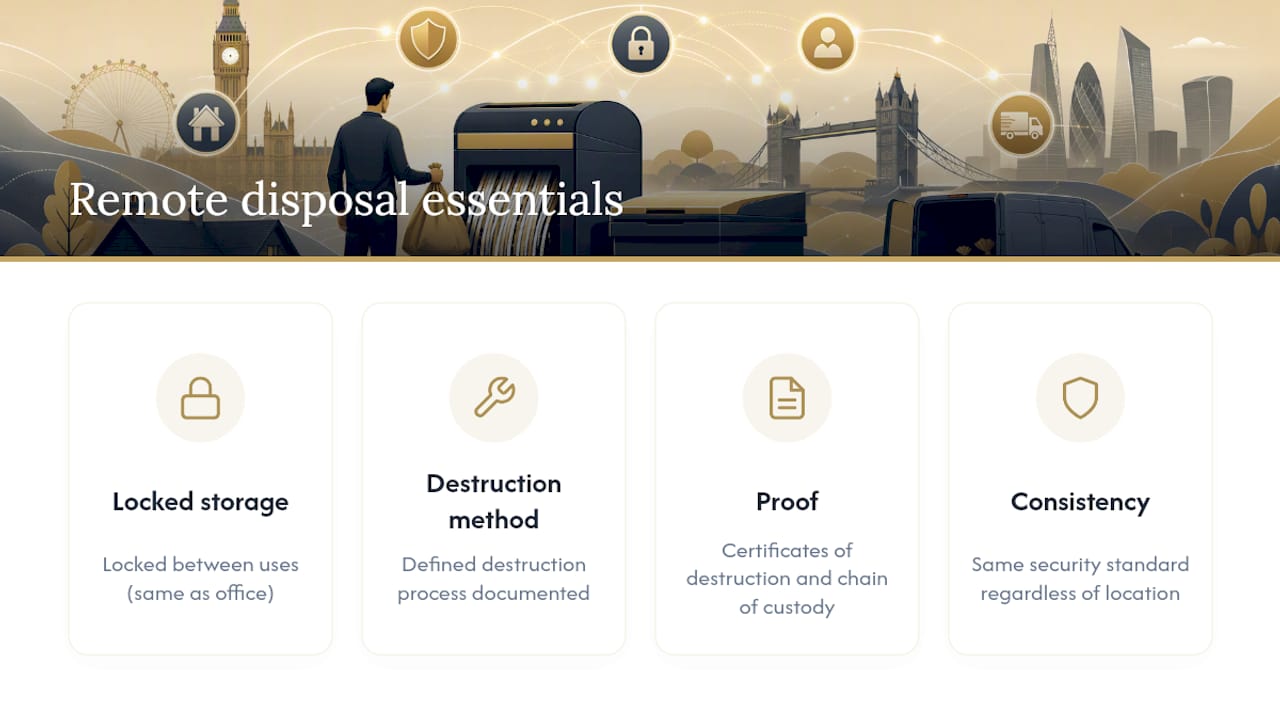
UK GDPR requires organisations to apply appropriate technical and organisational measures to protect personal data, and the ICO’s guidance makes clear this obligation doesn’t pause when staff log in from a kitchen table. “Appropriate measures” for remote work means the same standard of disposal you’d expect in an office: locked storage between uses, a defined destruction method, and proof it happened.
Government guidance on remote working reinforces this by treating information security consistently regardless of location, rather than as a lesser standard for home settings. That consistency is exactly what auditors look for.
Certificates of destruction and a documented chain of custody matter because they’re the only evidence that disposal actually happened as claimed. Without them, you’re relying on staff memory during a breach investigation, which is not a position any compliance officer wants to defend.
What to shred: document categories and risk tiers for home offices
Not every piece of paper carries the same risk, so your remote worker shredding policy should sort documents into tiers rather than treating everything identically.
- High risk: payroll records, client contracts, HR files, anything with National Insurance numbers or financial details, needs certified destruction with a certificate.
- Medium risk: internal meeting notes, draft reports and supplier correspondence, usually fine for scheduled collection rather than urgent action.
- Low risk: printed emails with no personal data, general marketing material, can often go through a domestic cross-cut shredder.
Retention periods should trigger destruction, not just clutter. A payroll document past its retention date becomes a liability the moment it sits in a drawer rather than a shredding sack.
Approved disposal methods for remote workers and their pros/cons
Providers meeting recognised standards typically offer several service models suited to remote staff, and choosing between them depends on volume, urgency and how often someone visits an office.
- Scheduled collection: a locked bin or sack is collected on a set cycle, ideal for staff who generate confidential paper regularly and preserves full chain of custody.
- Drop-in “watch and view” shredding: you bring documents to a facility and watch them destroyed on-site, useful for occasional large clear-outs.
- Secure mail-back: tamper-evident prepaid bags suit fully remote staff who rarely visit an office, though turnaround is slower than local collection.
- Bring-back services: documents travel with staff to a central office collection point, workable for hybrid teams but weak if someone works from home permanently.
- Domestic cross-cut shredders: acceptable for low-risk paper only. They produce no certificate and no audit trail, and vendor compliance guidance is blunt about their limits for regulated records.
Match the method to the risk tier from the previous section rather than defaulting to whatever’s already sitting under the desk.
Policy essentials: what to put in your remote worker shredding policy
A written policy needs to survive an audit, not just look tidy on an intranet page. Structure it around these clauses:
- Scope and definitions: who the policy covers (all home-based staff, contractors, hybrid employees) and what counts as a confidential document.
- Approved disposal methods by tier: which route applies to high, medium and low-risk paper, mirroring the categories set out above.
- Provision and subsidy: whether the company supplies sacks or bins directly, or reimburses staff for an approved service.
- Storage and labelling: how documents wait for destruction between now and collection, locked container, out of sight, clearly marked.
- Transport expectations: rules for staff who occasionally carry paper to a central office or collection point.
- Escalation and consequences: what happens when a breach or missed shredding cycle occurs, and who investigates it.
Keep each clause short enough that a new starter can read the whole policy in five minutes. Complexity is what gets policies ignored.
How to implement: logistics, recordkeeping and proving compliance
Provisioning is the first practical step. Order secure sacks or consoles directly to home addresses so staff aren’t left improvising with bin bags, and set a collection schedule that matches actual document volume rather than an arbitrary monthly default.
Store certificates of destruction centrally, ideally linked to your existing data inventory, so a single search shows what was destroyed, when, and under which job reference. Building destruction evidence into supplier contracts as a standard deliverable stops certificates arriving inconsistently or not at all.
For mail-back services, track the tamper-evident bag from despatch to confirmed destruction. A gap in that chain is exactly what an ICO investigation would ask about first.
Training, monitoring and audits for remote disposal
Onboarding should cover shredding policy alongside other security basics, not as an afterthought buried in a handbook. A short annual refresher keeps the rules front of mind, particularly given survey evidence showing 24% of UK home workers don’t always follow workplace destruction policies, with only 34% consistently shredding or recycling paper used outside the office.
Monitoring doesn’t need to be heavy-handed: sample-check certificates against expected volumes, and ask staff to confirm collection dates. Build a simple audit checklist covering missed collections, lost documents and any incident where paper went into general waste by mistake.
Cost considerations and practical choices for employers
Pricing usually follows volume: per-bag or per-sack rates for occasional needs, scheduled contracts for predictable output. Secure-shred’s one-off collection service prices sacks with drop-off and destroy from £28 to £42, or £46 to £65 including collection, giving employers a fixed comparison point when budgeting.
Central payment is easier to audit than employee subsidy, since receipts and certificates land in one place. Weigh the modest cost of scheduled collection against the far higher cost of a reportable breach.
Why home-office shredding should be treated as essential infrastructure
Remote work isn’t a temporary arrangement any more, and a formal shredding policy should sit alongside VPN access and device management as standard provision. Good provision cuts human error, strengthens audit readiness, and gives staff confidence they’re not personally liable for a paperwork slip. The best policies stay simple enough that people actually follow them.
— Dan
Get your remote shredding policy working with Secure-shred
Secure-shred gives Cardiff and South Wales employers a local alternative to juggling ad-hoc courier bookings or relying on staff to self-certify their own bin bag shredding. Every job runs on GPS-tracked vehicles with CCTV monitoring, so the chain of custody your remote worker shredding policy depends on is backed by traceable evidence, not a promise.
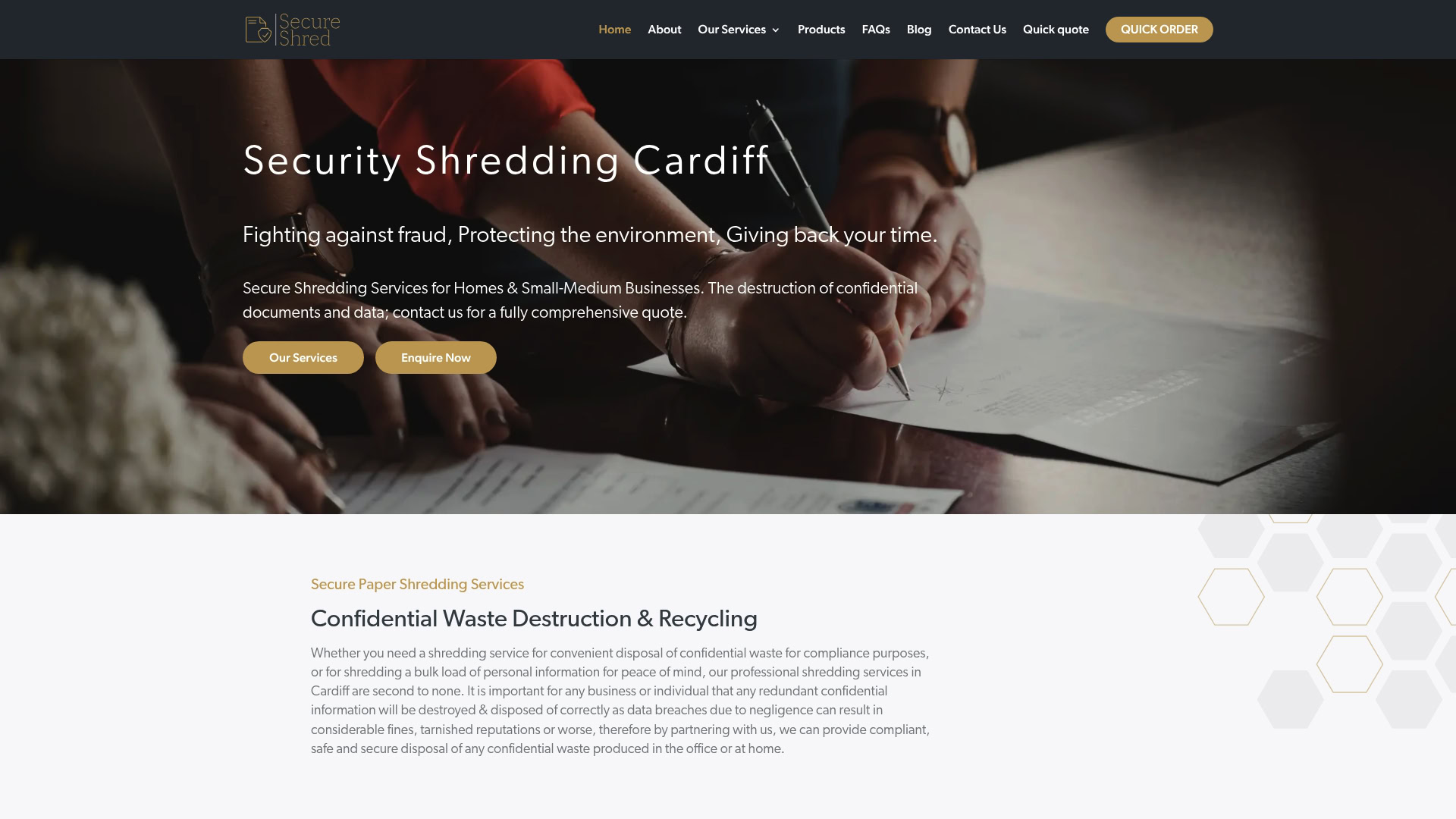
For remote and hybrid teams, the fit is straightforward. Home & Small Office Shredding covers scheduled collections for staff who generate confidential paper regularly, while the one-off collection service suits occasional clear-outs, priced from £28 for drop-off sacks up to £220 for large lockable wheelie bins. Every job comes with a certificate of destruction, giving compliance officers the paperwork an audit will ask for. If your organisation needs company-wide provision, the business packages extend the same on-site and off-site options across teams.
Get a quote for your team’s collection schedule, or book a one-off sack through the services page to see how the certificates arrive.
Sources
For the legal detail behind this policy, start with the ICO’s UK GDPR guidance on data security obligations. For destruction standards, look up BS EN 15713 and DIN 66399 P-4, the benchmarks referenced throughout industry guidance on home-office shredding.
FAQ
Where can I shred papers for free in the UK?
Free shredding is limited mostly to occasional community recycling events or council-run confidential waste days, which aren’t reliable for ongoing business compliance. For regular remote worker shredding policy needs, a paid collection or drop-off service with a certificate of destruction is the safer route for anything containing personal data.
How much does it cost to shred documents in the UK?
Costs vary by volume and method. Secure-shred’s drop-off and destroy sacks run from £28 to £42, sacks including collection from £46 to £65, and large lockable wheelie bin collections from £70 to £220 depending on volume.
How do I dispose of shredded documents in the UK?
Once shredded by a certified provider, the resulting paper waste is typically baled and sent for recycling as part of the service, closing the loop without you handling loose shreddings yourself. If you shred at home, mixing shredded paper loosely into recycling can still expose fragments; a sealed bag reduces that risk but doesn’t provide the audit trail certified disposal does.
Is it really necessary to shred receipts?
It depends on what’s on them. A receipt showing only a purchase total and store name carries low risk, but one with a card number, signature or account reference should go through certified destruction rather than the general bin. When in doubt, treat it as medium risk and shred it rather than assume it’s harmless.